
As they transitioned from military custody to administrative processing, the capture of Jerusalem in 1187 marked a turning point in the nature of medieval warfare. Saladin’s capture of the city was not the mad, violent scramble that had characterized the last assault in 1099 but a costly commercial venture. It was a conquest of capture, not destruction. In the Ayyubid empire, the vanquished were no longer expendable objects of religious violence, but important resources for the making of money.[1]
In the waning hours of the siege, it was reported rather than battles that made the news. The surrender was a huge effort that turned defeat into money and people into human resources. Thus, the conquest would be creating a terminal income for the Sultan’s treasury, with set tariffs imposed on each citizen in the city.[2] Instead, the historical record of the period depicts an image of negotiation, pricing, and controlled releases, rather than anarchy.
Whereas the debate over the problem has centered on religious compassion versus a more calculated sort of self-restraint, economics appears to lead towards the latter. Such types of self-restraint were not simply questions of individual morality, but were an essential component of their state-building process.[3] The Ayyubid rulers were able to transform a city of rubble into a useful and profitable locus of power by sparing the city and its inhabitants in exchange for a ransom.[4]
Terms of Surrender: Pricing Human Survival
Once Jerusalem had fallen into their hands, the people turned from combatants to assets on a ledger of human capital. It was resolved between Saladin and Balian of Ibelin that nothing but money should trade in death or life. As a replacement for the previous method, the Ayyubids adopted a taxation policy, which placed greater emphasis on liquidity than violence.
The Tariffs of the Displaced
According to the surrender agreement, ransom prices were set so that the individuality of the displaced people was sacrificed for demographic categorization. This facilitated the evacuation process while increasing tax revenue for the Sultan’s coffers. According to the Chronicle of Ernoul, the official prices were: “ten dinars for a man,” “five dinars for a woman,” and “one or two dinars for a child.”[5]
Tariffs were not only a tax but also a classification of demographic segments. The Ayyubids made exiles into classifications through the imposition of tariffs according to sex and age. In summary, life was dependent on the repayment of the standard debt. To put it differently, the multifaceted issue of religious and ethnic conflicts became a simple economic matter.
Administrative Window and Collective Bargaining
To speed up the huge migration, the Sultan imposed forty-day payment deadlines. Such windows aided in preventing collective bargaining issues.[6]
Furthermore, ransom payments were collectively negotiated. Deals were reached when the city’s impoverished could not afford the individual rates. Balian of Ibelin, for example, was able to spend a single sum of 30,000 dinars to release seven thousand people from the city’s impoverished population.[7] It should be highlighted that these techniques guaranteed a large-scale audit during the surrender, guaranteeing that all individuals were classified as either compensated assets or prospective slaves.
The Abstraction of Survival
While this system assisted survival, it also defined the exact conditions under which survival was feasible. Scholars, including Christopher Tyerman and Thomas Asbridge, recognized the systematic nature of this capitulation, but what is most important about the established conquest system is the abstraction behind it.[8] After 1099, population quantification became more than just a rupture; it was also used to fiscalize the conquering process.[9]
Payments, Enforcement, and Control
The treatment of the surrender by the Ayyubid government in 1187 is more about protocol than any kind of human drama. The only thing that started counting in life at this time was paying money, and during the transition, the army of the Ayyubid government had two duties: counting money and enforcing payment.
Verification and Sequential Exit.
There was rigorous, sequential monitoring of people’s exits from Jerusalem. Captives did not simply walk out freely. Their exit came after a thorough examination of the current ransom system. The Ayyubids maintained control of the city during the inspection process until all of the liquid value had been removed. People were only allowed to leave in convoys to the coast after providing the required dinars.[10]
The Mechanics of Economic Exclusion
In 1187, the new transition process changed the nature of medieval violence, shifting from direct physical termination to economic exclusion. It is apparent that those who could not afford to pay had no choice but to face execution or servitude. If the ransom was not paid, they would be captured and enslaved right away. Many Christians who did not have the gold were forced to become captives and were assigned to the Sultan’s army.[11] As a result, the slave market became the final destination for any “insolvent” individuals.
Bureaucratic Enforcement and Oversight
During the transition, Ayyubid rule was distinguished by a well-organized administration rather than haphazard pillage. To handle thousands of discussions relating to hostage release,[12] the Sultan hired negotiators and guarantors to oversee the entire process. Such an approach requires the existence of an organizational system geared toward resource capture by violence. It is clear that, while violence[13] did not go away in 1187, it was redirected into economic extortion.[14]
Revenue Redistribution and Military Stability
The conquest of Jerusalem provided the Ayyubid Empire with substantial financial resources to sustain a huge and complex military force. The Sultan was able to turn what could have been a reckless waste of Jerusalem’s wealth into an efficient and deliberate strategy of ensuring military stability by manipulating the surrender process.
The Centralization of Spoils
Rather than relying on the customary technique of decentralized looting, which would have risked shattering the army’s command structure, the Ayyubids ensured centralized gathering of riches. Rather than leaving plunder distribution to individual soldiers, who would just take what they could get, ransom payments and other assets acquired were funneled to a single central collection center. In other words, Jerusalem’s wealth was audited first and then dispersed.[15] This meant that the Sultan kept complete control over all spoils obtained.[16]
Fiscal Cohesion and Command
This system of regulated financial flow served as a cohesiveness device for the Ayyubid military. With guaranteed earnings from the central payment system, there was little room for discipline and dissipation difficulties. This shift from being motivated by enthusiasm to adopting a professional budgeting process helped increase the dedication of the soldiers to the center.[17] Financial benefits were not just a consequence of this triumph but were equally important elements of the system that helped retain a diverse army in unity. Using the local population as a ransom and the city as a payroll base, the Sultan was able to secure his men and ensure that his victory in conquering Jerusalem would serve as the foundation for his next military campaign.[18]
Processing the Population: Exit, Retention, and Order
The transition of sovereignty from the Latin Kingdom to the Ayyubid power base required a progressive evacuation of the city’s population. The evacuation did not involve the harsh cleansing of the inhabitants, but rather followed a set plan.
It should be noted that Jerusalem was turned from a Latin city to an Ayyubid city through a systematic and planned displacement of the residents. While no one was displaced, residents were displaced out of the city through legal and economic means. This process ensured that the city remained an integral part of geography and politics.
Regulated Exit and Residual Retention
The people’s leaving Jerusalem was an activity that was watched intently. Those who paid the ransom — men, women, and children who gathered the needed sum in dinars — were permitted to leave the city in organized groups, sometimes led militarily to the coast safely. It was not an anarchic exodus but a well-organized leaving process.[19] Those who were unable to pay remained as the residue of the conquest. This group of people would be either detained or conscripted into the slave system and became the property of the state after the forty-day deadline expired.[20]
Interventions and Financial Mercy
There were times when the rigidity of the tariff policy was tempered through certain acts. Yet, these instances took place within the boundaries of the financial approach. Latin and Muslim writers have cited cases where slaves were freed through the direct payment by other individuals or even by the Sultan himself, showcasing his mercy.[21] Instances of mercy involve the large-scale purchase of slaves by Balian of Ibelin and the unique liberation of certain types of offenders by the Saladin regime. Yet, these merciful acts did not depart from the financial approach but merely enhanced it.[22]
Preservation of the Urban Symbol
Because the takeover was an administrative operation rather than one targeted at full devastation, the urban symbol’s infrastructure can be preserved. The shrines and historic buildings remained undisturbed since the goal of the siege was to capture the holy place’s center of authority rather than demolish the entire structure.[23] Although historians commonly view this conclusion as an act of kindness on the part of the Muslim invaders, the truth lies in the need to preserve the city’s holiness by exploiting the citizens as valuable assets.[24]
Ransom versus Massacre: A Strategic Substitution
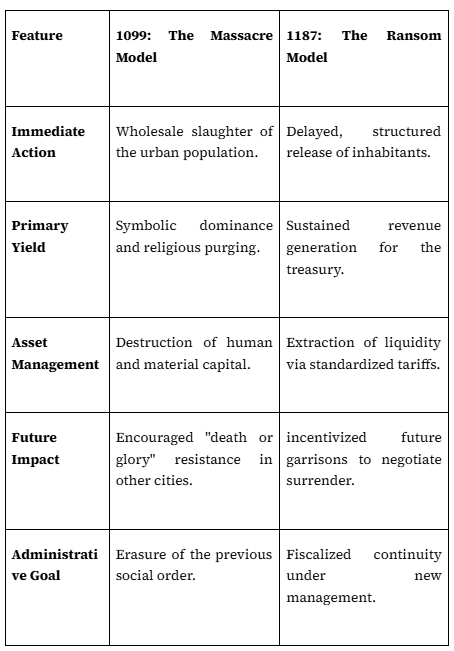
In 1187, Jerusalem marked the transition from the “rupture” stage of absolute devastation to the “succession” stage of transition during the medieval period of warfare. The Ayyubid state’s plan for establishing power includes replacing the sword with the ledger.
Strategic Substitution: 1099 vs. 1187
The Instrument of Policy
The choice to ransom the city was not only chivalrous on a personal level but also strategically sound. Although scholars such as Thomas Asbridge emphasize the importance of such deeds in making Saladin appear virtuous in front of both his Islamic and Christian contemporaries, this was just a byproduct of a practical decision.[25] The death of the residents in 1187 would result in a ghost town with no infrastructure and no cash stream. Saladin used a budgetary strategy to achieve capitulation, guaranteeing finances to pay off his soldiers while demonstrating to other Crusader-held cities that survival can be purchased.[26] With this strategy, it became easier to conquer more cities because their occupants saw surrender as a possibility.[27]
Conclusion: The Political Economy of Survival
The fall of Jerusalem in 1187 signified the conclusion of a paradigmatic change that went from the chaotic nature of battles during the Crusades to the politics of survival in a political economy context. While the fall of Jerusalem was not the conclusion of the war, it signified the transformation of the very basis of war itself. The Ayyubid state applied the concepts behind a rational policy of ransoms by applying the more systematic processes of auditing in place of the chaotic nature of war. Each stage in the process played an important role in state building: the terms of surrender organized the populace into clear classes, the price standardization eliminated the chaos of personal haggling, while the strict collection enforced full submission.[28]
It led to the monetization of human beings by converting the earnings into means of preserving military unity by dispersing them through the central authority. By implementing this financial approach, the Sultan maintained the long-term viability and legitimacy of his reconquest by sustaining the city’s urban infrastructure and religious stability.[29] In other words, it was a war shift in which violence became conditional, and loss was negotiable.
Finally, Jerusalem was not captured, but rather processed through a financial system in which the use of force could be converted into a tool of policy, indicating that the most successful exercise of power is one that can successfully monetize its own victories.[30]
And, while this bureaucratic ability to commodify conquest served him well against foreign, conventional state actors, it provided little protection against decentralised, asymmetrical domestic threats that rejected the fundamental limits of medieval statecraft entirely.
References
- Ibn Shaddad, The Rare and Excellent History of Saladin, trans. D. S. Richards.
- Edbury, The Conquest of Jerusalem and the Third Crusade. (accessed April 27, 2026).
- Hillenbrand, The Crusades: Islamic Perspectives. (accessed April 27, 2026).
- Jonathan Riley-Smith, The Crusades: A History, 3rd ed. (accessed April 28 2026.)
- Peter W. Edbury, The Conquest of Jerusalem and the Third Crusade.
- Ibn Shaddad, The Rare and Excellent History of Saladin.
- Imad al-Din al-Isfahani, al-Fath al-Qussi.
- Tyerman, Christopher. God’s War: A New History of the Crusades. (accessed April 28, 2026).
- Asbridge, Thomas. The Crusades: The Authoritative History of the War for the Holy Land. (accessed April 29, 2026).
- Ibn Shaddad, The Rare and Excellent History of Saladin.
- Edbury, The Conquest of Jerusalem and the Third Crusade.
- ‘Imad al-Din al-Isfahani, al-Fath al-Qussi.
- Lev, Saladin in Egypt.
- Tyerman, God’s War.
- Ibn Shaddad, The Rare and Excellent History of Saladin.
- ‘Imad al-Din al-Isfahani, al-Fath al-Qussi.’
- Lyons and Jackson, Saladin: The Politics of the Holy War.
- Richards, D. S. The Chronicle of Ibn al-Athir for the Crusading Period from al-Kamil fi’l-ta’rikh, Part 2. (accessed April 27, 2026).
- Edbury, The Conquest of Jerusalem and the Third Crusade.
- Ibn Shaddad, The Rare and Excellent History of Saladin.
- Imad al-Din al-Isfahani, al-Fath al-Qussi.
- Tyerman, God’s War.
- Asbridge, The Crusades.
- Hillenbrand, The Crusades: Islamic Perspectives.
- Asbridge, The Crusades.
- Tyerman, God’s War.
- Jonathan Riley-Smith, The Crusades: A History, 3rd ed.
- Lev, Saladin in Egypt.
- Lyons and Jackson, Saladin
- Tyerman, God’s War.