

Thus, the consolidation of Ayyubid power could never be based solely on budgetary operations;it took place against a backdrop of a political environment characterized by many non-governmental actors who posed dangers from within. Against this backdrop, one should particularly pay attention to the experience of the Nizari Ismailis, whose name was translated into medieval histories as Hashshashins. Whereas the Latin Crusader states engaged in open warfare through direct conflict, the Nizaris developed an entirely novel concept of power struggle: asymmetry and personal assault. Their goal was not to defeat the Ayyubid army but to destabilize its governance.
This time, the threat came from the royal court in the shape of an unexpected violation of the Sultan’s inner circle. In the book “Rare and Excellent History of Saladin,” in addition to Imad ad-Din al-Isfahani’s chronicle of his own life, there is a depiction of various moments of imminent peril, such as assassination attempts at the sieges of Aleppo and Masyaf.[1] Such events caused a shift in the Ayyubid dynasty’s concept of rule. Power could no longer be based solely on military strength; a more complicated and comprehensive security governance plan was required.
The conflict with the Nizaris forced the Sultan to shift from a strictly military policy to one based on continuous readiness for prospective threats. According to scholarly sources such as Farhad Daftary’s and Marshall Hodgson’s writings, the Nizaris’ operations were deliberate and planned.[2] As a result, Saladin’s government needed to be capable of managing unseen threats and developing a security management apparatus similar in structure to the financial one. In the end the Sultan’s authority relied on his capacity to rule not just the apparent frontiers of his realm but the murky areas of the court itself.[3]
Assassination as Structured Political Violence
The premise of Nizaris was to target specific persons, making the ruler’s body a direct target of political threats. As a result of avoiding a traditional military field of operations, the Nizaris moved their focus to Saladin’s immediate neighborhood.
The Mechanics of Proximity
The Nizaris’ guiding idea was to use the least amount of force possible to accomplish the greatest political result. According to historical data, the close proximity of actions was achieved using unique approaches. Assassinations, in particular, were carried out with a blade to create psychological suffering following physical assault. During the sieges of Aleppo and Masyaf, the Nizaris adopted disguise to get near the sultan.[4] It is critical to note that these were well-planned operations rather than random acts of terror. The Nizaris’ primary purpose was to disable the Ayyubid state’s leadership without engaging in combat or seizing lands.
Access as a Weapon
Access emerged as a defining factor in this regime of institutionalized violence. The Nizaris demonstrated that, no matter how well-protected a leader was, he could still be contacted by his enemy if he chose to. This type of force was distinct from military techniques used against civilian populations; in fact, what distinguished it was that escalation was not the key component, but rather the repetition of the operation. When an attack was unsuccessful, it did not indicate failure, but rather a constant state of preparedness placed on the Ayyubids.[5] These instances are intimate breaches of security that redefined the meaning of political danger, pushing the stakes from the border of the camp to the interior of the tent.[6]
Rationalized Pressure
Instead of a random killing spree, the assassination strategy was used to put pressure in a rationalized manner. Political selectivity was used as a key bargaining tactic with military supremacy in this strategy. Individuals were targeted rather than military personnel, allowing the Nizaris to exert authority and influence well beyond their numbers. In this scenario, Saladin realized that maintaining stability within his own state required more than just border defense, but also dangerous elements of visibility and leadership.[7] In essence, the presence of the dagger threat would drive him to live an insulated and professionally protected existence.[8]
Structural Limits of Military Retaliation
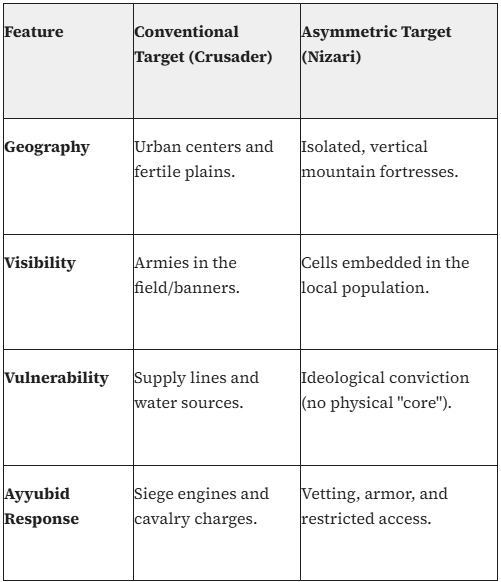
The Assassins’ ongoing challenge highlighted a clash between the Ayyubids’ traditional military prowess and the new method of warfare. Whereas Saladin led great armies against the Crusader powers in regaining towns, these armed forces were ineffective in dismantling the network because there was no regular battlefield.
The Failure of Territorial Suppression
Traditional military offensives proved futile in their attempts to overcome the system of fortress bases employed by the Nizaris. Whereas traditional military offensives sought to isolate an opposing force within a fortified urban center, such as a city-state, or eliminate an opposing army in open battle, the Nizaris conducted operations from geographically scattered fortified mountain bases, which were extremely difficult to penetrate with conventional siege warfare tactics. Though Saladin attempted to challenge and attack the strongholds of Nizaris, such as Masyaf, the danger persisted. As can be seen from historical records, even during military operations against the Nizaris, the danger existed, suggesting that merely controlling the geography was not enough to subdue an enemy without any territory.[9]
Decoupling Power from Geography
The Nizari resistance movement could not be crushed because it was deeply ingrained in society and worked in secret. There would be no “decisive engagement” because the network lacked a destroyable core point.[10] While military forces could be deployed to protect the camp’s perimeter, they could not successfully deal with agents operating within the Ayyubid empire’s social and military systems. Despite Saladin’s territorial expansions, the threat persisted. The fight was not one of position, but of a decentralized body capable of regenerating itself quicker than it could be attacked.
The Transition to Security Governance
The Nizaris’ tenacity demonstrated that the state’s challenge was no longer military in nature, but rather one of security. The community’s decentralized structure meant that the capture or death of their leadership would not jeopardize their survival. The Ayyubid state was compelled to refocus on domestic control after failing to conquer the faceless network by force.[11] Force no longer served as a means for projecting power, but rather for fortifying the Sultan’s surroundings.[12] Saladin’s inability to meet the enemy in a final military clash meant that the Nizaris could no longer be viewed as anything more than a continual administrative burden to be dealt with.[13]
Security Regime: Protection, Surveillance, and Control
The response to constant danger from murder that was neither concrete nor visible was that Saladin turned his immediate environment into one where there was security, necessitating close monitoring. This change in turn meant that the focus of the Ayyubid regime was no longer on external imperialism but rather on personal security; hence, proximity control became important for regime survival.
The Architecture of Insulation
In reaction to the impending threat of being killed, the Ayyubid court established a strict security system[14] that contained the following three components:
Restricted Access: Only members of a carefully selected entourage were granted unrestricted access to the Sultan’s area, acting as a living barrier between the Sultan and any potential assassin.
Fortified Campsite: The campsite was renovated with numerous layers of defense, making the Sultan’s tent a safe haven rather than just a command center.[15]
Constant Alert: The campsite was constantly ready to respond to an attack since staff were always prepared for the possibility.
Governance Through Surveillance
This security apparatus shifted the Ayyubid regime’s priority away from military combat and toward monitoring and intelligence collection. Governance was now based on selective contact. Below is a table that demonstrates how the threat posed by insiders altered the operational framework of the Saladin government leadership:
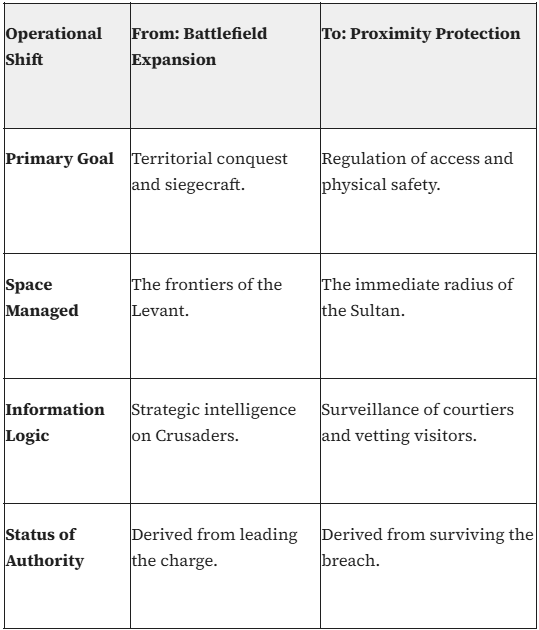
With authority based on the ability to control those who could attack them, the Ayyubid state became a more responsive and bureaucratically protected dictatorship.[16] This enhanced responsiveness helped ensure that the Sultan could continue to command the war campaign without danger of being stymied by individual threats of violence.
After failing to completely annihilate their opposition militarily, the Ayyubids made a significant shift by adopting a diplomatic strategy rather than aiming to destroy their adversary. Saladin understood that he couldn’t completely remove the Nizaris through violence, but he could make them harmless in the context of a firm agreement not to participate in combat.
This was not diplomacy; it had nothing to do with the parties’ mutual understanding or respect.
Diplomatic Engagement and Strategic De-escalation
As a result of the inability to defeat the Nizaris by use of sheer brute strength, a new perspective came into existence. Instead of the objective being to wipe out the group, the intention would now be to achieve a peaceful situation using diplomatic relations. Saladin understood that although it was not possible to wipe them out, he could neutralize them diplomatically.
Transition to Pragmatic Diplomacy
Eventually, the Ayyubid state will have had to resort to negotiation processes with the Nizari leadership. This process required the Ayyubids to make a drastic shift in their perception of the Nizaris. Instead of being “assassins” who need to be hunted, they had to be seen as an entity that needs to be dealt with politically. This came at a time when there was a drastic decrease in the number of attacks recorded.[17]
The Logic of Non-Aggression
As a result, the Nizaris were neither defeated nor capitulated. What happened was that the nature of the engagement stabilized into a non-aggressive state. Saladin was able to acquire the peace that military siege could not provide by accepting his own limitations. As a result, while the forts remained standing, the Sultan and his family were no longer targets for assassination.[18] This was not a concession, but rather a negotiated settlement that involved survival at the expense of eliminating the dangers.
Strategic De-escalation and Focus
The eradication of this menace provided the Ayyubids with the ability to refocus their attention on the Crusader nations, which was a significant benefit. Prior to this, the presence of an internal threat meant that a portion of the Ayyubid effort was always dedicated to the inside. Saladin was able to redirect his armies’ attention toward the reconquest of the Levant after eliminating the personal threat to himself and his allies.[19] Strategic partnerships between diverse sectarian groups were promoted during times of crisis in order to reduce internal instability.[20]
Diplomacy as a Security Instrument
Diplomacy stood out as a weapon for security rather than politics. The transfer into the talks process could be attributed to the Ayyubid leadership’s responsiveness to the obstacles faced by asymmetric warfare. As a result, by treating the non-state actor as an equal in negotiations, the state kept its identity and safeguarded the safety of its leaders during the struggle with the Latin cities.[21] This is because the peace reached was not founded on a shared set of beliefs, but rather on common survival.
Containment without Absorption
The Nizaris’ dilemma was solved through containment rather than conquest. In contrast to the Ayyubids’ expansion policy towards the Latin city-states, the confrontation between the state and the Nizari Isma’lis was handled in such a way that the group was not absorbed into the empire.
The Logic of Externalization
According to the Ayyubid administration, some areas could be integrated while others could not. Those in the towns that had been conquered, like Jerusalem, were enlisted, taxed, and absorbed into society, whereas the Nizaris were deliberately left out of the social setup. No records have been found detailing a conquest of their mountain range or the destruction of their leadership structure.[22] Rather, they remained independent. This policy was based on the fact that keeping an army amongst the Nizaris would have been too costly.
Autonomy as a Buffer
Through bestowing self-rule upon the Nizaris, the Sultan converted a constant element of conflict into a settled yet distinct neighbor. The strength of the Nizari movement proved itself through the realization that even though the Ayyubids put their most successful efforts forward, they could only cut off the sources of threats instead of bringing down the entire network.[23] Therefore, an unprecedented political environment was created where a person who did not belong to the government was permitted to exist without being interfered with by the government. Saladin wanted neither to govern the Nizaris nor be governed by them.[24]
Conclusion: Governing the Invisible
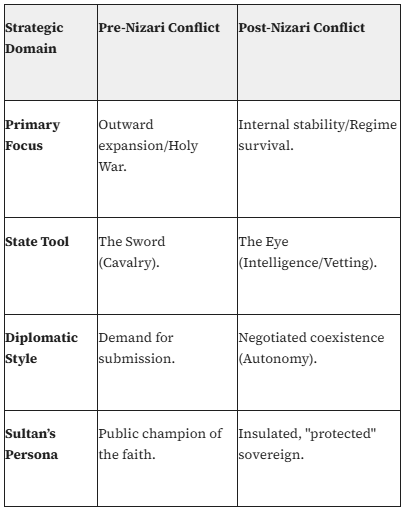
A closer study of the negotiations with the Nizari Isma’ilis reveals another aspect of the Ayyubid government in which the rulers were more concerned with the deft handling of invisible perils than territorial expansion. Saladin’s rule was defined by major strategic adjustments, which enabled his regime to transition from a position of acute peril to one of security. The threat to the ruler’s life posed by assassination forced monarchs to shift their focus from battlefield superiority to internal reorganization via monitoring and control of entry and departure points.[25]
However, the threat wasn’t eliminated; it simply became predictable and manageable for Saladin.[26] It allowed him to maintain control of the country and devote his whole attention to the military campaign without being distracted by internal strife. This occurrence demonstrates that effective control in medieval times in the Near East was dependent on the capacity to manage information and deal with enemies who were outside the reach of direct military action. The core of power was eliminating something that couldn’t be defeated. It demonstrates that successful statecraft may be built on a combination of security and diplomacy, and that a ruler’s primary trait is the ability to rule behind the scenes.
However, while this adaptive, invisible leadership may have been capable of countering any decentralised insurgency from within, it was abundantly clear that its flaws would be exposed the moment it faced an overwhelming conventional coalition. The delicate world of political manoeuvring came crashing down the moment the Third Crusade arrived, forcing a shift to the rigour of full-scale battle.
References
- Ibn Shaddad, The Rare and Excellent History of Saladin.
- Farhad Daftary, The Assassin Legends: Myths of the Isma’ilis (accessed April 28 2026.)
- Marshall G. S. Hodgson, The Order of Assassins: The Struggle of the Early Nizari Isma’ilis against the Islamic World, (accessed April 28 2026.)
- Ibn Shaddad, The Rare and Excellent History of Saladin.
- Daftary, The Assassin Legends.
- ‘Imad al-Din al-Isfahani, al-Fath al-Qussi.
- Bernard Lewis, The Assassins: A Radical Sect in Islam (accessed April 28 2026.)
- Marshall G. S. Hodgson, The Order of Assassins.
- Ibn Shaddad, The Rare and Excellent History of Saladin.
- Daftary, The Assassin Legends: Myths of the Isma’ilis.
- Hodgson, The Order of Assassins.
- ‘Imad al-Din al-Isfahani, al-Fath al-Qussi.
- Lewis, The Assassins.
- Ibn Shaddad, The Rare and Excellent History of Saladin.
- Tyerman, God’s War.
- Lev, Saladin in Egypt.
- Ibn Shaddad, The Rare and Excellent History of Saladin.
- ‘Imad al-Din al-Isfahani, al-Fath al-Qussi.
- Asbridge, The Crusades.
- Daftary, The Assassin Legends.
- Hodgson, The Order of Assassins.
- Ibn Shaddad, The Rare and Excellent History of Saladin.
- Lewis, The Assassins: A Radical Sect in Islam.
- Daftary, The Assassin Legends.
- Ibn Shaddad, The Rare and Excellent History of Saladin.
- Hodgson, The Order of Assassins.