
The shift from indirect coercion to direct structural collision meant that the Siege of Acre saw a significant shift in strategy from the fast-paced tactics used after Hattin. It was a plunge into an unbreakable impasse in which the privilege of maneuvering strategies was sacrificed to the unrelenting mathematics of entrapment. Commanding during the siege of Acre was no longer about victory; it was all about assessing the degree of defeat that could be tolerated. The change resulted in a complete system of mutual coercion, with operations lasting over two years.
In the historical study of the siege, the critical role of controlling reinforcement and minimizing the pain caused by the environment is highlighted.[2] The historical texts continually point to difficulties in obtaining food and the psychological impact of prolonged anxiety, which proves that the wars happened in an environment where both sides competed for logistics. In such a case, victory was not won through fast occupation but through making sure that the army had enough resilience and coordination in the midst of continuing strain.[2] Therefore, Acre serves as an illustration that medieval warfare was characterised by the management skills of sustaining supply chains and keeping soldiers’ spirits up in the face of a disintegrating society.[3]
As a result, Acre exemplifies how medieval warfare was more than just a test of endurance, but also a complicated interaction of the seasons, cyclical ebbs and flows of morale, and financial insolvency. Success, as can be seen, was dependent on the general’s ability to navigate the changing geography of the disease environment without bankrupting his coffers.
The Double-Siege System and Operational Paralysis
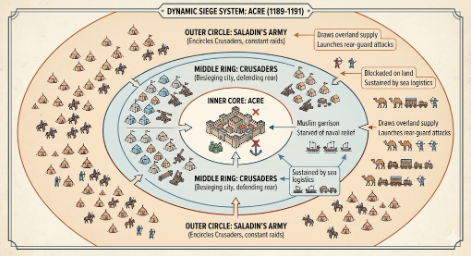
The advent of twin sieging tactics, a unique and stifling approach that completely revolutionised the nature of combat, was the most distinguishing element of Acre’s military system. The crusaders lay siege to the city while Saladin’s army surrounded it. In other words, two opposing troops were trapped up in an odd battlefield, with no way out.
The Naval Bottleneck: The Egyptian Navy as Saladin’s Strategic Achillies’ Heel
Although the “Double-Siege” technique on the ground worked well as a tight circle of mutual pressure, Saladin’s grand strategy had one key vulnerability: his fleet was in the water. To keep the city standing, the Muslims besieged within need an uninterrupted supply of seawater. However, the Ayyubid fleet could not cut off the Crusaders’ naval routes across the Mediterranean.
The Egyptian fleet was always at a disadvantage because of its structural flaws.
- Resource Deprivation:Due to a lack of high-quality woods (such as oaks and pines) and iron required to build an effective fleet capable of lengthy voyages, the Egyptians were forced to rely on intermittent supply of lumber coming from Anatolia.
- Manpower Deficits: Unlike the Italian seafaring states of Venice, Genoa, and Pisa, which supplied highly skilled sailors to the Crusaders, Egyptian ships relied on seasonal, press-ganged recruits.
- Operational Reach: The Ayyubid galleys were largely defensive in character, with a limited reach.
Thus, every time the Egyptian fleet attempted to break through the blockade into Acre’s port, as when it tried to sail into the harbour with fifty ships during the winter of 1189, it ran a significant risk. Due to Saladin’s inability to control the sea, the Crusaders maintained a stable supply line from Europe, which was critical to their survival.
The Anatomy of the Deadlock
Acre experienced a tri-lateral system of deadlock. The Muslim soldiers were resisting from within the walls; outside the walls, Crusader troops were undertaking siege operations; and outside the siege lines, Saladin’s armies threatened the Crusaders from the outside.[4] This created a suffocating scenario for the Latins, with competing priorities. They needed to defend their camp from the Sultan’s men while also laying siege to the city and defending their supply chain across the water.
Overlapping Vulnerabilities
This organizational system necessitated a level of coordination that physical restrictions prevented. The Crusaders’ offensive assault on the city’s walls would result in the immediate collapse of their lines of defense if Saladin’s light cavalry struck their rear positions. On the other hand, Saladin’s frontal attack on the Crusader trench lines may have an impact on his capacity to maintain general control of the surrounding country.[5] This circumstance created an effective military impasse in which traditional tactics were no longer applicable.
The Mechanics of Exhaustion
While the double-siege prevented any movement on the ground, it turned time into an enemy for both parties. Instead of depending on tactical talents to ensure success, each group’s ability to withstand the stress of a double-siege became vital.[6] Both sides’ chroniclers documented the physical and mental strain of an eternal siege, remarking that in some ways, the line between besiegers and besieged had faded entirely.[7] With the standoff ongoing, the war became one of the best examples of operational paralysis in the history of the Crusades.
The Mediterranean Tether: Naval Power and Geopolitical Logistics
The land-based nature of Ayyubid military history frequently obscures a key geopolitical fact: the state was constantly vulnerable to maritime encroachment.
Saladin’s mounted bowmen governed the Syrian heartland, but the Italian maritime republics of Venice, Genoa, and Pisa wielded unparalleled naval might along the Levantine coast. The Ayyubid navy’s major flaw was its internal ecology. Egypt and Syria had been deforested for years; the Sultan had to import timber and iron through dangerous, illegal trading networks with Byzantium. It would prove a critical naval weakness in the lengthy Siege of Acre. The Ayyubid navy was gradually decimated on open water, allowing the Crusaders to preserve their’maritime tie’ with Western Europe, bringing a steady stream of new provisions, strong siege engines, and reinforcements directly into their trenches. In contrast, Saladin’s naval strategy in the Red Sea was one of complete rejection. In response to the situation, the Ayyubids suffered administrative chaos due to their adversary, who sent his pirate fleet on a mission to attack Mecca and Medina. Al-Adil ordered that the shipyard in Alexandria be dismantled, and the materials were mounted on camels for transport to Suez, where they were reassembled. The Red Sea force chased and destroyed the Frankish ships, transforming the southern waterways into an exclusive Muslim territory that defended both Eastern trade interests and Saladin’s theological eschatology.
Maritime Supply and Inland Logistics
The ability of the two opposing armies to survive until the last battle would be heavily reliant on how well their logistics supply systems performed under strain. As the landlocked situation worsened, the struggle became one of endurance, with the military campaign being driven by the movement’s defense over dramatically different terrain.
The Divergent Lifeblood of War
There was no denying that both factions were involved in radically different types of logistics operations. On the one hand, the Crusaders’ supply chain was headquartered in the Mediterranean, which provided them with crucial sustenance. The maritime route allowed the required supplies of provisions and reinforcements from all over Europe to arrive in time to keep the troops marching.[8] At the same time, Saladin’s army could draw sustenance from overland trade networks that linked various sections of Syria and Palestine.
Naval Arrivals as Strategic Rotors
In this context, the advent of a ship fleet represented more than just the arrival of supplies, but also a significant shift in the power balance. The reinforcement ships rescued the Latin soldiers on multiple occasions, delivering much-needed manpower and encouragement at critical periods.[9] These naval arrivals served as rotor machines for the besiegers, allowing them to continue their operations over time; a successful docking operation could help reverse several months of attrition. On the contrary, any obstruction in the commerce channel owing to meteorological conditions or Ayyubid naval activity would induce terror and anxiety among the Crusaders in their trenches.
The Logistical Bound of Tactics
The Battle of Acre demonstrated that the ability to participate in tactics was inextricably linked to the movement of logistics. Military might was intimately connected to continual movement along supply lines,[10] regardless of how well-trained the soldiers were or how powerful the siege devices were. The Sultan saw the key to success as blocking the city’s seaborne supply route while also ensuring that his own overland convoys arrived safely and without being ambushed by the Crusaders. The war had spread to granaries and ports just as much as it had to the battlefield.[11]
Disease, Scarcity, and Environmental Attrition
As the siege progressed, the primary means of attrition shifted from the weapons wielded by the opposing forces to their surroundings. Non-combatant variables were now accountable for making camp stacking more dangerous and devastating through loss of life. Time has evolved into an active agent of physical destruction, rather than a simple backdrop context for strategy.
The Disease Ecology of the Trenches
The double-siege affected the physical environment, shifting the disequilibrium in the disease ecosystem. Being held captive in a stagnant and marshy floodplain with contaminated water sources, the camp became a breeding ground for infectious diseases through vector-borne and waterborne ways. The biological terrain developed a predictable, cyclical pattern in response to changing weather conditions, transforming the physical environment into a biological force.
Biology of Attrition.
The cost of living during the siege frequently exceeded the number of deaths caused directly by conflict. The concentration of mankind and beasts of burden in immobile, dense strata resulted in a severely unfavorable environmental cycle. According to historical reports from both sides, the following dangers contributed to attrition:
Malnutrition: Intermittent food shortages caused hunger among the army’s surviving troops.
Contaminated Environment: A lack of sanitary precautions led to the poisoning of campgrounds, with “camp fever” and diarrhea spreading rapidly.[12]
Animal Loss: Both Saladin’s light cavalry and the Crusaders’ heavy knights lost their mounts, limiting their mobility.
Exhaustion: The prolonged period of vigilance over two years made minor wounds potentially fatal.[13]
The Ecology of Famine, Sanitation, and Desertion
The Famine Crisis: Winter blockades impeded sea arrivals, resulting in horrific starvation among Crusader men in the trenches. There was hyperinflation in the camp; one loaf of bread and a horse’s head were highly expensive and could no longer be purchased by any soldier.
Toxic Environment and Disease:To cram nearly 100,000 humans and animals into a small and immovable space was to build a biological time bomb. The lack of sanitation meant that the plains were littered with waste and dead bodies. When it rained, the camp turned into a muddy quagmire, polluting well water and generating outbreaks of typhus, scurvy, and dysentery.
Social Fracture and Desertion: As society fell apart owing to hunger and disease, malnutrition grew so severe that Christian soldiers began to defect, infiltrating through their own ranks at night to surrender to Saladin’s garrisons, trading their religion and strategic knowledge for food. In a similar pattern, exhausted peasant conscripts from the Ayyubids vanished into Syria’s interior.
Indirect Erosion of Capability
The case of Acre shows how long-run conflict degrades operational capability through an indirect process of degradation. As the climate deteriorated, the line between military defeat and the inability to live became ever more blurred. The environment of the siege placed a metabolic stress on both sides . They spent more energy on biological survival than tactics.[14] This was a long process, and therefore, as the siege progressed, the soldiers were less and less able to recover from casualties sustained in battle. To sum up, control in Acre required less outward projection of power and more inward maintenance of an increasingly unsustainable biological infrastructure.[15]
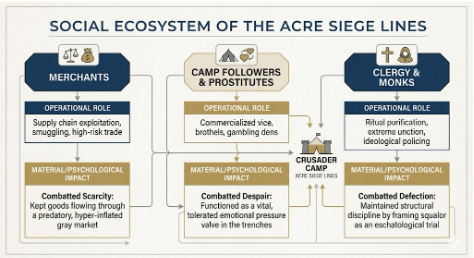
The Trench Metropolis: Merchants, Vices, and the Camp Economy
Under the directives of higher leadership, the siege at Acre evolved spontaneously into a military ecology in its own right. This ecology, which was not involved in any combat actions, became the true driving force behind the siege operations, preventing the troops from crumbling.
- The Merchant Economy: A complicated web of Italian sea traders, Syrian Christians local to Syria, and European merchants developed a wild bazaar within a walled market town beyond the battle lines, all with the goal of making money. They engaged in perilous smuggling activities, including wine, grain, and guns, using aggressive financing and exchanging goods for seized gold and armour.
- The Function of Vice:To combat the psychological impact of the protracted siege, hundreds of prostitutes and camp followers set up shady tents and gambling houses in the trenches. Despite the priests’ strong objections, the commanders did not discourage this underground commerce.
- The Eschatological Core: The plentiful Latin pastors, monks, and bishops stood in direct opposition to this degeneracy, using the horrific mortality rate to impose discipline. They performed funeral-like parades, interpreted famine as God’s judgment, and even practised extreme function.
Morale, Reinforcement, and Command Decisions
Increasingly, the decisions chosen throughout the siege were influenced by the shifting psychological state of the warring factions. As the situation continued to stalemate, the internal situation within the belligerents’ camps began to be as vital a factor as the defensive position of the city. The command decisions were no longer just technical operations, but responses to material depletion and growing worry about the collapse of the institution. The key problem for Saladin was how he could preserve the loyalty of the motley collection of local emirs, for these local emirs, military success on the ground was essential.
In such circumstances, morale was not a sentiment but an objective product of the struggle for existence. A new convoy would not only provide reinforcements, but it would be an anchor, in which discipline would be held, and the time that military operations could be carried out would be prolonged. On the other hand, every missed chance to score, every week of stalemate added another layer of physical and psychological exhaustion to already weary bones. The number of casualties and the lack of resources became too serious, thus no more harmful tactics could be used.[16]
The leadership in Acre was also under a lot of pressure because of the protracted period of standoff, which didn’t allow for the kind of decision-making that generally elevates a leader’s status. The crucial element of authority in this situation was to maintain confidence in the face of obvious deterioration. The choice to negotiate or withdraw from the city was frequently based on maintaining some form of strategic coherence within the army ranks rather than a movement in military objectives.[17] Finally, the ability to control military exhaustion became the ultimate test of government, showing that endurance was the most precious resource in a war of complete immobilization.[18]
Strategic Fatigue and the Cost of Persistence
One thing that was widespread during the siege’s last moments was strategic tiredness, which went beyond fatigue and became a case of being unable to mount an offensive. The Ayyubids and Crusaders had become trapped in a predicament in which staying put would lead to their demise, but fleeing was not possible.
The Politics of Attrition
Strategic exhaustion was defined by a lack of ability to take decisive action, leaving both parties completely reliant on outside assistance to keep their operations running. Saladin was continuously under strain as he had been on the battlefield for nearly two years, making it increasingly difficult for him to perform his military commitments in the region.[19] At the same time, the Crusaders were continually engaged in a costly process of replenishing losses through naval campaigns.[20]
Even with this rising fatigue, the siege had to continue since the political connotations of giving up would outweigh the practical implications of remaining. The Sultan was unable to abandon such a vital area due to a loss of legitimacy and potentially even a breakdown of strategy on the coast, whilst the Latins could not afford such a humiliation because it would practically terminate the Third Crusade before it began. This scenario transformed Acre into an attrition case study.[21]
Conclusion: Acre and the Mechanics of Endurance
The siege of Acre is an example of the complicated process of logistical, psychological, and ecological endurance on which medieval warfare of long duration was founded. Every step of the fight added to the growing chain reaction that settled the character of the battle at hand. The double blockade resulted in utter paralysis, while the cut-off of supply lines reduced the combat effectiveness of both the Ayyubids and the Crusaders. Disease and starvation spread and hastened attrition, and the length of the conflict produced a strategic lassitude that reduced the offensive capacities of the opposing armies.[22]
In the end, no one stroke of tactical genius determined the Battle of Acre. Instead, it was a war of attrition, and the side able to bear the greater physical and mental suffering prevailed. The Siege of Acre indicates that in long-term combat, military strength is based not simply on tactical skill but on the capacity for long-term organizational endurance. The armies in question did not just have to deal with pressure from the enemy but also with the constant drain of being in the field, which was not only starvation but also the effects of procrastination and the physiological toll of static entrenchment. In this theater of exhaustion, the ability to withstand the friction of time proved more decisive than the ability to breach a wall.[23]
After the fight evolved from a stationary siege to a mobile war fought along Palestine’s coast, structural weariness prompted a move to a nonviolent approach. Because they couldn’t physically destroy the Western attack, the Ayyubid state turned the clocks that had drained their framework against them.
Visualising the “Donut of War” at Acre
To demonstrate the spatial arrangement and operational paralysis of the twin sieging tactics at Acre, the structural impasse can be visualised below:
References
- Ibn Shaddad, The Rare and Excellent History of Saladin.
- Asbridge, The Crusades.
- France, Victory in the East.
- Ibn Shaddad, The Rare and Excellent History of Saladin.
- France, Victory in the East.
- Tyerman, God’s War.
- Itinerarium Peregrinorum et Gesta Regis Ricardi, trans. Helen J. Nicholson,(accessed April 29 2026.)
- Ibid.
- John H. Pryor, The Age of the Δρομών: The Byzantine Navy and the Struggle for the Mediterranean, (accessed April 29 2026.)
- Ibn Shaddad, The Rare and Excellent History of Saladin.
- Asbridge, The Crusades.
- Itinerarium Ricardi, trans. Nicholson.
- Ibn Shaddad, The Rare and Excellent History of Saladin.
- Jonathan Phillips, The Holy Land in the Era of the Crusades, (accessed April 29 2026.)
- Asbridge, The Crusades.
- Itinerarium Ricardi, trans. Nicholson.
- Tyerman, God’s War.
- Asbridge, The Crusades.
- Ibn Shaddad, The Rare and Excellent History of Saladin.
- Itinerarium Ricardi, trans. Nicholson.
- France, Victory in the East.
- Itinerarium Ricardi, trans. Nicholson.
- Asbridge, The Crusades.