
The centre of gravity shifted from moving quickly over vast plains to being orderly and alone in the city. The Holy City’s main garrison was annihilated on the battlefield.
The fall of Jerusalem was not marked by any brutality on Saladin’s part, he used a strategy of slowly weakening the defences of Jerusalem through negotiation and engineering. Despite the popular image of the fall of Jerusalem being a brutal affair, the fall took place because of a prolonged weakening of the defences of Jerusalem through sieges rather than by brutality.
The residents of the city’s situation throughout the siege is widely chronicled, as they transitioned from resistance to supplication with God. The historian Ernoul recalls the following
“Then they began to make a great and piteous procession… the ladies of Jerusalem took basins and put them before the Mount of Calvary, and put cold water in them, and made their daughters sit in the water up to their necks; and they cut off their hair and threw it away. And they cried to God, and to the Mother of God, and to all the saints, that they should have mercy on the city.”[1]
The decline of the city came from the slow decline of its strength in warfare and in mental toughness, instead of sudden destruction. By the time Saladin deployed his artillery, the city was already deprived of all sources of supply, and its army was defeated at Hattin. It is not a sudden conquest; it was just part of the sustained effort that compelled the city to surrender due to its undeniable understanding of its own plight.[2]
Sacred Architecture: Jerusalem as the Eschatological Anchor
To understand the life of Saladin from 1174 to 1187 is to misunderstand the basic idea of how things operated in the Levant in the 12th century if it is solely through the prism of tax systems and military movement. Jerusalem was never merely a place to get stuff from. It was also a test of sacred geography, which is an eschatological need. The seizure of the city was Saladin’s final validation of the Sunni values he had worked so hard to build. Latin domination transformed the *Al-Aqsa Mosque* such that it became the Knights Templar’s home. A golden Christian cross was put on top of the *Dome of the Rock*. In the eyes of the Islamic world, this was an undesirable shift in the universe.
This symbolic scenery clearly told Saladin how to move his army strategically. The reconquest was carefully planned to happen on the date of the Prophet Muhammad’s *Isra’ and Mi’raj* (Night Journey) and (Ascension). This turned what was supposed to be a military surrender into a sign of God’s will. When Saladin took back the Haram al-Sharif, he wasn’t just protecting a fortified hill; he was also purifying the place in a religious way. Taking down all the Christian altars, washing the outside of the buildings with rosewater from Damascus, and installing the pulpit (*minbar*) that Nur al-Din had ordered decades before were all structural conditions of his legitimacy. Without the symbolic retaking of Jerusalem, the Ayyubid state stayed a weak military dictatorship. With it, Saladin’s power grew from a temporary regional government to an invincible protectorate that was approved by God.
Siege Technology and Deployment
The attack on Jerusalem started with the systematic use of physical power instead of attacking directly through the gateways. Saladin used a systematic siege technique that involved using artillery power against the city.
The Mechanism of Attrition
These siege engines were utilized as part of the barrage, delivering a continual battering without allowing the defence to restore calm and breathe again. Medieval texts describe the beginning of the Ayyubid army’s relentless bombardment,[3] which comprised strikes so persistent that the enemy had no time or opportunity to rest throughout the day or night.
Such tactical attacks can be considered as a continuous “darb” of enemy troops designed to exhaust the opponent’s strength and make him lose hope of holding his position. In medieval Near Eastern siege operations, such techniques were frequently preferred over attempts to break down defences.[4]
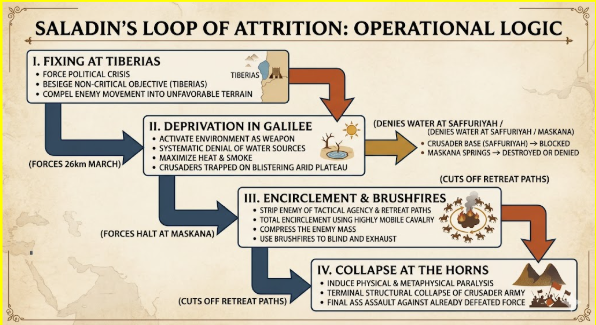
Visualising the Cycle of Attrition
This is the flow of Saladin’s strategic pressure, which will help you understand how he exploited logistics and geography as weapons:
Preparing the Collapse
The primary goal of these siege engines and other attack mechanisms was to prepare for a total collapse. According to a historical study, the primary benefit of utilizing such siege engines was their capacity to undermine both the masonry of the walls and the mentality of the defenders.[5] These processes did not win the war right away, but they did help to prepare for it.
Saladin’s engineering staff uncovered holes in the defences by focusing their fire on specific places, ensuring that by the time of the final attack or negotiations, all resistance had been successfully eliminated. In this sense, the siege became a form of administrative operation in which the defence network was gradually destroyed through repetitive mechanics.[6]
The Barrage Cosmic Verdict
This constant mechanical attack (darb) had two purposes: it was needed for engineering reasons, and it also served as a political court. For the Muslims who were watching, each stone thrown at the Frankish walls was a sign of God’s judgement, showing that the Christians’ time in charge of the holy places was coming to an end. On the other hand, the constant artillery fire shattered the soldiers’ illusion of divine protection that had held the Latin Kingdom together since 1099. Saladin’s artillery didn’t just hit buildings; it also attacked the religious authority of the Crusaders’ presence, making the siege look like a cosmic correction that had to happen.
Mining and Structural Weakening
The key moment for the siege of Jerusalem was when the Ayyubid forces changed their approach to not only besieging but also undermining the defences. While the mechanical weaponry kept the defenders in a state of psychological imbalance, the physical fortifications proved unsustainable on their own.
Structural Removal of defence: The Mechanics of Mining
Sending miners (naqqabun) to weaken the northern walls contributed significantly to Saladin’s success in the Siege of Jerusalem in October 1187. To understand this strategy, any misconceptions about it must be cleared up. Mining wasn’t only about using explosives to blow up walls, and it wasn’t just about excavating a “hole” to crawl through. It was a meticulously prepared strategic assault on the enemy’s defences.
It worked through a very precise engineering process:
- The Sap (approach): Miners dug a trench or shallow tunnel to the base of the stone curtain wall. They managed this under the cover of huge timber shelters, termed “cat-castles,” and artillery fire.
- The Gallery (Under-excavation): The miners dug directly beneath the enormous stone pillars of the wall to discover a spacious underground room known as “the gallery.”
- The Shoring: While the earth and stones were dug out from beneath the wall, gigantic wooden supports, beams, and scaffolding were used to temporarily support the enormous weight of stonework overhead. The wall looked like it was hung from a wooden cage.
- The Combustion (collapse): To make the breach, the miners crammed the room with dry brushwood, straw and pig fat — all very combustible stuff. They set the beams ablaze and ran. The wood supports smoked away, and the weight of the structure did the rest. The enormous stone curtain wall, its base of support gone, collapsed in on itself, providing a sloping slope of rubble for the attacking army to use.
Saladin’s engineers deliberately carved out the foundations. They did not merely break through the wall; they caused the city’s fortifications to sink into the ground.
Subterranean Displacement
Saladin’s miners were looking for the essence of the city walls’ stability as they dug beneath them. Their mining operations were thus not dependent on the strength or height of the walls, but rather on the ground beneath them. According to the chronicler Ernoul:
And when they had undermined the wall and put fire to the props, the wall fell down. And when the wall had fallen, the Saracens ran to the breach, and they set up their banners on the wall. And the people of the city could not defend it, for they were few and weak, and the Saracens were many and strong.[7]
Using fire to set ablaze the wooden structures supporting the section near Damascus Gate meant an organized demolition process, allowing the Ayyubid army’s soldiers to avoid the thick defences of gateways and towers, thus finding a way into the city that the weakened defence would be unable to seal.[8]
The Removal of the System
Mining is a frequent strategy in Near Eastern warfare because it reduces the likelihood of high-casualty attacks, which are typical of Western siege warfare. At the time of the collapse, the wall was no longer under attack; instead, it was being destroyed to be removed as a protective system.[9]
The wall was no longer just a gap in a structure; it represented the utter depletion of all engineering and physical resistance possibilities. In this situation, as some history indicates, mining was one of the critical ingredients that enabled the success of Saladin’s military strategy of seizing fortified sites.[10]
Pressure on Defenders: Exhaustion and Moral Breakdown
In addition to destroying its physical structure, the siege of Jerusalem sapped the will of the beleaguered defenders psychologically. Saladin’s strategy implied that when the walls fell, so did the city’s moral and spiritual will, as well as any social cohesion it may have had. As a result of such a psychological impact on the city’s inhabitants, Jerusalem began to collapse long before the walls were even demolished.
The Anatomy of Despair
In combination with the deteriorating situation on the battlefield, the public participated in severe religious activities, indicating that defeat was impending. According to contemporary records, the city was gripped with a sense of abject terror, with mothers subjecting their daughters to cold water showers and shaving off their hair in penance for the upcoming slaughter.[11]
These were not just an affirmation of their beliefs, but showed that the limits had been reached inside. If “moral despair” is instilled among the troops in medieval siege warfare, then it may prove as effective as artillery. Siege succeeds when those who are being besieged lose all hope for deliverance in either physical or divine means.[12] Surrender does not happen when walls fall down; it happens before that, when there is a psychological breaking down.[13]
The Threat of Total Ruin
The final phase of the siege entailed a change from the literal destruction of walls to political domination of the city. The restoration of Jerusalem, both physically and spiritually, is what made Saladin’s mission during this war worthwhile; any violent destruction of such a holy place meant that Saladin’s objectives were not met. This was achieved by negotiations between the Balian of Ibelin and Saladin.[14]
The conversations were founded on a real fear of mutual destruction, which was made more perilous by the recollection of the murder of 1099. The Christians defending themselves were feeble because they were terrified. They understood what happened when a crusader city was besieged, and they anticipated the same thing to happen. However, Balian utilised his anxiousness as a bargaining chip for his life. He assured Saladin that he would pursue a “scorched-earth” policy of destroying all Islamic holy places and slaughtering all tens of thousands of Muslim captives. It was not a cold strategic calculation, but a suicide mission to save the people. Balian had made Saladin adjust his intentions so he would obtain nothing but ash and dead bodies. It changed a moment of imminent destruction into an accepted path to survival.
The threat proved effective, and a peaceful conclusion became possible. The deal protected the land’s integrity as well as the Christians’ quiet departure.
Managed Evacuation and Ransom
The collapse of the city took place using the ransom and evacuation technique. The demands made by Saladin were quite practical since their goal was to ensure that the area fell under the control of the Ayyubids.[15]
The surrender followed a predetermined ransom process in which money was required for each adult male, female, and child to be released. If someone could afford the ransom, he or she was allowed to depart the city with property. Notably, the Sultan and his brother graciously freed numerous slaves who were unable to pay for themselves. This way, Jerusalem would stay functioning and dynamic, demonstrating that Ayyubid strategies focused on the use of force to secure conditions of submission rather than annihilation.[16]
Latin Panic and the Void: The Shock of Loss
The administration of the Saladin siege was well-managed, but the Latin American people were going through a very terrible time on a moral level. To many who lived within the walls, the coming fall of Jerusalem felt not like a peaceful transfer of power, but like the end of the world and the abandonment of God.
Latin dread swept the sacred precincts as it became evident that the northern wall was likely to collapse. Priests, not to take the gold and silver decorations from the churches, but to melt them down and use the coins to pay the ransoms. People were so unhappy and desperate that they barricaded the roadways leading to the Holy Sepulchre. This local anxiety intensified, and when the news reached Europe over the Mediterranean, it created tremendous disruption. Western historians said that the loss of the city was such a shock that Pope Urban III died abruptly. Supposedly, it stopped all of Christendom in its tracks and led to a desperate clamour for a New Crusade over the whole continent. Yes, he’d emptied the fortress, but he’d also weakened its defences and hit at the emotional centre of the medieval society in the West.
Comparative Frame: 1187 vs 1099
The transformation of Jerusalem that occurred during the year 1187 proved to be a significant milestone in the history of medieval siege warfare. While the assault of the First Crusade on Jerusalem was characterized by its brutality, ending with the conquest of Jerusalem and the death of its inhabitants in the year 1099, the later siege was characterized by efficient engineering and politics.
The Failure of Direct Assault
The First Crusade of 1099 included a hurried and dangerous assault plan in which the invaders barely breached the wall once. This resulted in the rapid physical and social breakdown of the walls, with the assailants bursting into the city and murdering its citizens shortly thereafter. In 1187, Saladin’s armies used protracted mechanical damage as well as wall structure mining. No soldiers were allowed to enter the city until the walls’ defences were disabled.
The Diplomacy of Survival
The most noticeable distinction is the way in which the conquered people are treated. While the defeat in 1099 resulted in a massacre that was recorded by chroniclers as having been accomplished while “wading through blood,” the capitulation of 1187 followed a very defined legal and financial procedure. This can be seen in the following quote from Ernoul:
And when the city was surrendered… then was the cry made through the city that every man should pay his ransom, and that they should have forty days to pay it. And those who could not pay their ransom within the forty days should be the slaves of the Saracens.[17]
A Controlled Transition of Power
This change of devastation into discussions is indicative of a shift in political thinking recognized by historians as part of the Latin East’s political maturation. While the devastation of 1099 was indicative of a “rupture” mindset, the capture of Jerusalem in 1187 was indicative of “succession.” Saladin’s employment of a ransom policy contributed to a controlled transfer that safeguarded the city’s holiness while also generating a large sum of money for the Ayyubid regime through ransom payments.[18]
Jerusalem was handed over in 1187 instead of merely being “captured.” To make sure that its takeover by the Ayyubids could be considered a restoration, Saladin emphasized terms for capitulation rather than mass murder.[19]
The Propaganda and Pan-Islamic Response: Legitimacy Engine
When Jerusalem fell, Saladin quickly became more than a Kurdish military strongman in the region; he became a mythological figure, invulnerable everywhere in the Islamic world. For almost a decade, his enemies in Baghdad and northern Syria had derided his campaigns as opportunistic land grabs, self-serving and at the expense of other Muslim dynasties. The retaking of the Holy City put an end to this opposition at home.
The triumph was weaponised by the Ayyubid chancery (Diwan al-Insha), which sent formal victory letters (kutub al-fat’h) to everyone in the Middle East, from the Abbasid Caliph in Baghdad to independent amirates in distant locations. These papers did not see the peaceful conquest of Jerusalem as a brilliant example of mining engineering, but as a clear indication of God’s love.
Saladin orchestrated a grand, famous purification ritual, replacing the cross atop the Dome of the Rock with a crescent, distributing thousands of silver coins to the religious elite, and hosting grand victory assemblies, thereby creating a pan-Islamic coalition unprecedented in hundreds of years. The city was not merely an addition to the empire’s territory; it also provided the authority which kept it functioning long after the siege lines were gone.
Conclusion: Siege as Engineered Transformation
Siegecraft is a deliberate, controlled change. For example, consider the siege of Jerusalem in 1187. Instead of a huge attack, the taking of the city was not a cataclysmic assault but a calculated sequence of physical force, psychological attrition and negotiated surrender. In the end, Saladin did not storm the stronghold; rather, his engineers painstakingly destroyed its ability to resist, reducing war to a controlled administrative transfer.
The desperation of its defenders, the collapse of its walls at the Damascus Gate, and the setting of a ransom are all pieces of a well-coordinated plan for the destruction of the city, which had nothing else to offer other than an act of capitulation.’[20]
Indeed, the fall of Jerusalem took place not at the time when Saladin conquered the city but when the walls failed to be an obstacle any longer, when the besieged acknowledged their detachment from the rest of the world and opted for the more practical option of negotiation instead of the absurd one of total annihilation. The Ayyubids merely viewed the whole siege as an administrative measure for the event’s success.[21]
This negotiated retreat converted what might have been a slaughter into an administrative capitulation. The conquest quickly evolved into a complex business arrangement rather than a military exercise in siegecraft.
References
- “The Capture of Jerusalem, 1187,” Internet Medieval Sourcebook, Fordham University,(accessed April 28 2026.)
- Peter W. Edbury, The Conquest of Jerusalem and the Third Crusade: Sources in Translation, (accessed April 28 2026.)
- Ibid.
- Kennedy, The Armies of the Caliphs.
- John France, Western Warfare in the Age of the Crusades, 1000–1300.
- “The Capture of Jerusalem, 1187.”
- Ibid.
- Kennedy, The Armies of the Caliphs.
- Christopher Marshall, Warfare in the Latin East, 1192–1291 (accessed April 28 2026.)
- Edbury, The Conquest of Jerusalem and the Third Crusade.
- “The Capture of Jerusalem, 1187.”
- Hillenbrand, The Crusades: Islamic Perspectives.
- Edbury, The Conquest of Jerusalem and the Third Crusade.
- Ibid.
- Lyons and Jackson, Saladin: The Politics of the Holy War.
- Yaacov Lev, Saladin in Egypt.
- “The Capture of Jerusalem, 1187.”
- Christopher Tyerman, God’s War: A New History of the Crusades, (accessed April 28 2026.)
- Thomas Asbridge, The Crusades: The Authoritative History of the War for the Holy Land, (accessed 28 April 2026.)
- Marshall, Warfare in the Latin East.
- Lyons and Jackson, Saladin: The Politics of the Holy War.