
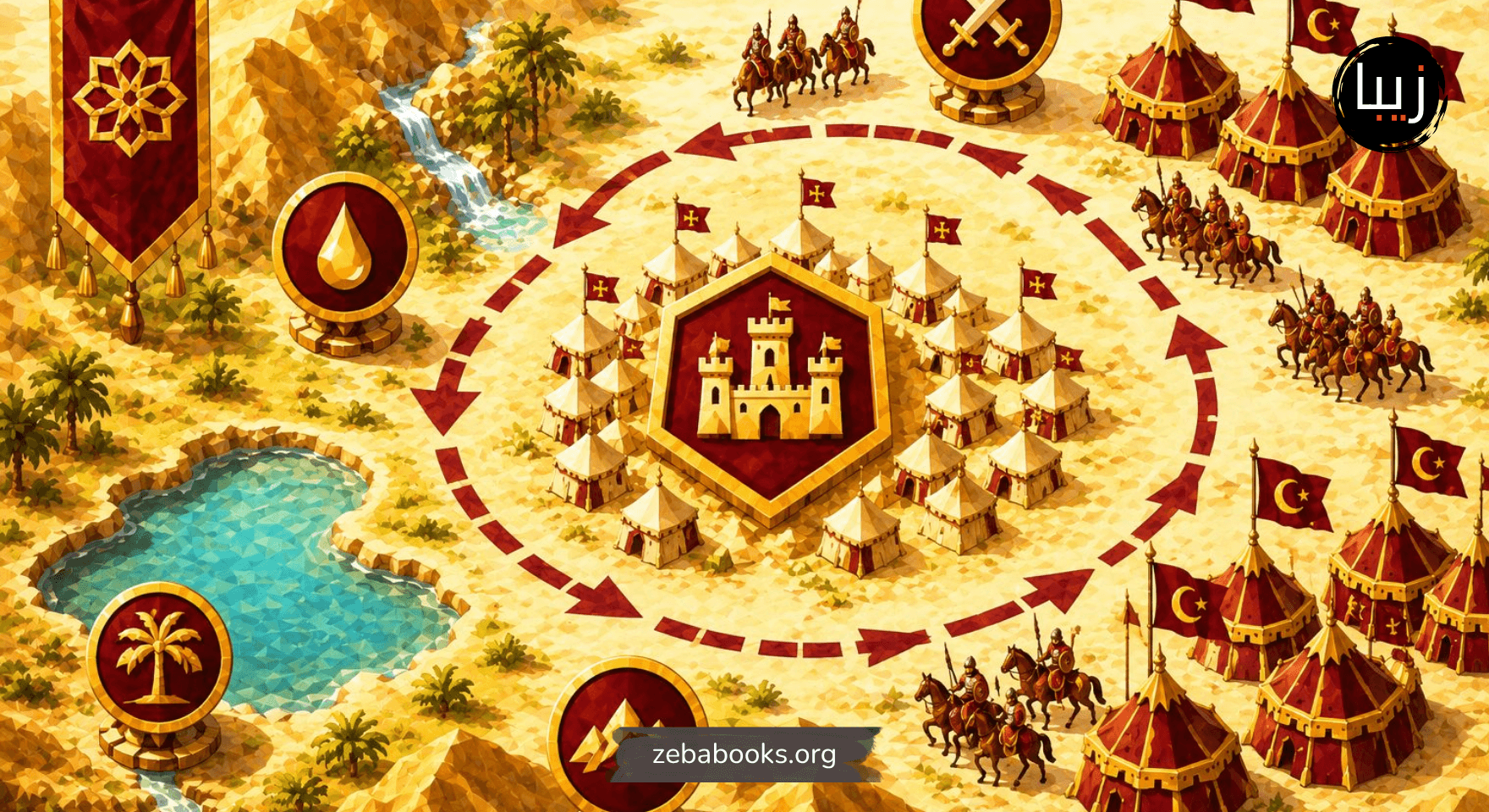
In contrast to the notion of a violent explosion or a courageous struggle won by a single moment of bravery, the struggle of Hattin was a meticulously planned degradation. The Crusader warriors experienced a planned collapse as a result of effective environmental manipulation and motion techniques. The Crusader troops were not destroyed or defeated; rather, they were simply exhausted before engaging in deadly conflict. Saladin’s attrition strategy had exhausted them to the point where they were reduced to lifeless bodies.
Only by advancing into a well-planned ambush did the Crusader troops suffer their actual and unavoidable defeat. A Latin chronicle from the time cautions that the army’s failure to move away from water could lead to the deaths of many men due to dehydration and heat.[1] Thus, rejecting the warning sealed the soldiers’ destiny. In other words, by luring the Crusaders to the dry plains of Galilee, Saladin dealt a fatal blow to their military might.
When the two sides eventually met in the Battle of the Horns of Hattin, the knights were fatigued and debilitated due to their great thirst and psychological isolation on the battlefield. According to historical research of the time, one of the most important aspects contributing to Muslim triumphs in conflicts was strategic location and the pace of the march before the real battle began.[2] The Battle of Hattin could be viewed as the culmination of the Crusaders’ protracted strategic process.
Strategic Positioning and Movement
Saladin won the battle against the crusaders thanks to his strategic location and movement over the geographical region. His interpretation was that it was more about directing the march than going into battle.
The Induced March
The disastrous miscalculation of advancing away from the water-ample base at Saffuriyah proved to be a watershed moment in strategic terms. The disaster began when the Crusaders decided to move into the terrain that Saladin had prepared for them in advance, they marched out… leaving behind the necessities of life[3] tempted by the siege of Tiberias.
To gain a clear image of how difficult this “weaponised terrain” is, consider how physically demanding the march is. The distance from the Saffuriyah springs to Tiberias, the target, was approximately 26 kilometres (16 miles). This walk in the July heat of Galilee would be difficult for a modern hiker who did not need to carry anything. In the Middle Ages, soldiers and heroes dressed in large padded trousers and chainmail faced certain death. With shields, swords, and iron helmets.
Saladin did not need to fight them; all he had to do was hold them off. The Ayyubid horse archers’ unrelenting pursuit slowed the Crusaders to a crawl. On July 3, they had only travelled 18 kilometres (11 miles) when they arrived in Maskana, which was 8 kilometres (5 miles) from the Sea of Galilee and had no water to spare. Saladin commanded this 26-kilometre maze of dry heat and frequent combat, transforming a routine army march into an impossible trap of bodily degeneration.
The decision to march signalled a move from a defensive strategy that had been sustained under King Baldwin IV, who had been overseeing the Crusader command, to prioritizing the preservation of the field army over any aggressive manoeuvre . This changed after the King died, and the rise to popularity of the Crusader faction led by Reynald de Châtillon and King Guy, who were known for their recklessness and aggression. The dead King’s stability and sanity helped Saladin be apprehensive of invading the Crusader land; the lack of such a force rendered the leaders vulnerable to the temptation to move on to Tiberias.
It was not merely the result of the objective logics of the move; rather, it was driven through sheer compulsion of immense power. Saladin ensured turning a simple advance into a gauntlet of attrition as soon as they had left the water behind, Saladin… harass[ed] them.[4]
Strategic Compromise
Saladin’s technique of forcing the Crusaders to travel through this parched region under constant harassment was successful in depleting their military capability. Forced marches were regularly used by medieval military strategists to psychologically weaken their enemies prior to battle. When the Frankish force eventually arrived on the plateau above the Sea of Galilee, they were already tactically crippled. They were no longer fighting an army; instead, they were fighting for survival, specifically water, as their formation collapsed and their horses died beneath them.[5]
Control of Water Sources: Logistics as Weapon
The Muslims could move freely across the Galilee while it was dry, but Saladin’s systematic control of water sources won him the battle of Hattin. Saladin’s logistics prevented the troops from arriving before the local water sources were secured. The Crusaders’ biggest tactical advantage was their heavily armoured cavalry.
The Production of Thirst
Not only did the summer heat cause problems for the Christian army, but it was purposefully designed to render them unable to fight. Saladin’s army surrounded the Crusaders, making it difficult to reach the streams of Saffuriyah and the Sea of Galilee at the same time.
The Crusaders marched as they fell apart because they did not have enough water.
As a result, the primary sources show that the soldiers believed they could not survive half a day without an abundance of water[6] and we are dying of thirst and we will not fight.[7]
Logistics as Confrontation
In Near Eastern warfare, denying the enemy resources was often a better strategy than attacking them directly. Saladin understood that without hydration, an army could not function and was effectively rendered ineffective. The Crusader knights were immobile owing to thirst, preventing them from traveling any further, they wished to go no further… constrained by… thirst,[8] leaving their mobility to the elements that Saladin had used.
It was only at this time that warfare began. Due to logistics, the knights, who were generally the area’s strongest element, became almost completely ineffective. This exemplifies an important feature of Muslim military doctrine: why take chances in a fight when you can defeat the enemy through weariness,[9] and this was accomplished with only a couple of properly placed springs.
Terrain and Environmental Pressure
In July 1187, the terrain of Galilee became more than just a backdrop to the war. Saladin did not just battle on the ground; rather, he weaponized the most difficult parts of the landscape to destroy the crusader force.[10] The blazing heat, desolate landscape, and plan of burning the enemy created an environmental pressure that proved too much for the highly armoured crusader knights.
The Weaponized Terrain
The Ayyubid tactics transformed the environment into a “scorching heat” gauntlet, with every component of the environment working in favour of the light and mobile Muslims against the sluggish and unwieldy Crusader armies. The demand was not just biological, but also logistical and environmental.
- Logistical Pressuring: The Ayyubid army used the terrain to trap the Crusaders in the middle of the plateau, assuring that they camped on a dry site.[11]
- Environmental Pressure: To shatter the Crusaders’ will, Saladin set fire to the desert around the encampment,[12] causing stifling pressure on both the troops and their horses.
- Tactical Adaptation: The Ayyubid soldiers used their greater adaptation to the surroundings to advance quickly, although being hampered by their equipment on the enemy side.
The activation of the terrain ensured that the Crusader army was defeated both on the ground and in the air, even before Saladin’s soldiers came into contact for the hand-to-hand conflict. During medieval Near Eastern battles, the tactician who was able to utilize natural forces in his tactics more successfully than anyone else invariably emerged victorious, regardless of how brave the other person was.[13]
Encirclement and Containment
The Hattin endgame technique was characterized by a deliberate encirclement procedure rather than a dramatic meeting of two large-scale troops. Rather than attempting to shatter the Crusaders’ ranks with a head-on attack with his light cavalry troops, Saladin preferred to encircle the Frankish forces with his men, trapping them behind their depleted lines.
The Ring of Fire
The terror created by being completely surrounded was almost as strong as the exhaustion itself. According to contemporary reports, Muslim warriors “the sons of Esau… surrounded the people of God,” [14]This was a dynamic ring, not a static one, which effectively prohibited coordination between Crusader elements in the front and back, where enemies sprang up on every side.[15]
This technique was supported by persistent harassing fire and an endless barrage of arrows. Saladin’s archers did not have to hit the target with every shot because their primary goal was to immobilize and disrupt the Crusader knights’ charge formation. The Ayyubids stole momentum from the Crusaders by keeping them continuously on guard.
Compression into Collapse
The siege was intended to render the army immovable and fragmented. In medieval warfare, if an army becomes stationary, it loses its ability to fight. The Crusader force was being pushed into an ever-shrinking region, causing a loss of cohesiveness and the outbreak of widespread fear. The warriors were packed up against each other in the sweltering heat, making it impossible for the knights to control their horses and use their weapons.[16]
The Frankish army did not fall to its enemies after a brave attack or an amazing display of prowess. Rather, the army fell because it was unable to escape constriction. By the time the Muslims arrived to arrest the King of Jerusalem and the True Cross, the Frankish army had collapsed due to its inability to break the chain of containment. The battle ended not with a bang, but with the total collapse of battlefield cohesion that had no room left to breathe.[17]
Feudal Vice: The Logic of the Frankish High Command
To dismiss the debacle at Hattin as a foolish act of folly or as a passive Frankish failure ignores the very strict political, legal, and structural constraints under which the Crusader council of war had to function. King Guy was acting on a desperate, feudal logic that made sense in its own right, which didn’t leave him much space to manoeuvre. The march into the arid region of Galilee was a gamble. Guy was willing to lose the fight rather than appear weak and have his partnership fall apart politically.
Baronial Coercion and Fractional Crown.
Guy of Lusignan was crowned by marriage, which made him suspicious. Many people distrusted him, and he was heavily battled by local lords such as Raymond III of Tripoli. Saladin attacked Tiberias, Raymond’s fiefdom, and Guy was instantly confronted with a constitutional problem.
The Assises de Jérusalem laws obliged a lord to physically defend his vassals in exchange for their devotion. If a lord failed to defend his vassal’s land, he forfeited his right to rule. If Guy had refused to march to its help, or if he had silently watched, he would have breached the feudal pact. This would have meant that the barons might have rebelled instantly, dividing the country while Saladin was away fighting.
Manpower Shortage and Arrière-Ban
This political trap was made much more hazardous by the Latin Kingdom’s vast military capabilities. Outremer was perennially short of knights and troops, and the surrender of even one fortress without a fight could jeopardise the entire frontier.
Guy was forced to call the arrière-ban, meaning he dispatched every Christian soldier available to fight, ensuring he had the same number of troops as Saladin. Despite this, the high command left the garrisons of Jerusalem, Acre, and Caesarea unoccupied in order to assemble this single force. There was no secondary line of defence. Saladin’s cautious, defensive strategy enabled him to conquer Tiberias, secure an unassailable stronghold in Galilee, and starve out unguarded remote fortresses. The kingdom could not afford to survive a long battle of attrition.
The Structural Inability to Retreat
They couldn’t change their tactics after committing to the dry plateau, and leaving would be difficult. As part of the Crusader military system, the infantry created a shield wall with crossbows to protect the heavy cavalry horses from horse archers who could manoeuvre around them.
If the High Command ordered a withdrawal when they were being seriously harassed, the soldiers would have broken formation to run toward the Sea of Galilee. They already believed they couldn’t exist without water. If they were killed, the kingdom would lose its labour force. On the other hand, if they marched slowly, Saladin’s light horsemen could gradually break up the column. Guy’s position, the scarcity of water, and the state’s laws forced him to gamble everything on one last offensive shock charge.
Breakdown and Collapse
The Loss of Cohesion
In the case of Hattin, the collapse manifested as a complete loss of formation and control over forces. According to accounts, as the pressure of the encirclement intensified, the battle formations were… broken up.[18] The knights had lost any advantage they could have had in the combat due to the infantry’s lack of protection and the movement given by their horses. The host became “confused and intermixed” with one another, eradicating all hierarchical order in medieval warfare.
This type of breakdown was characteristic of the Ayyubids’ fatigue tactics in combat. According to historian Ibn al-Athir’s account of the period, the goal of this manoeuvre was to reduce a well-organized formation to a panicked “flock” before administering the coup de grâce. By the time the army was disbanded, it had lost its fighting capability.
Systemic Failure
In a nutshell, it was the defeat and eventual dismantling of the Crusader army as a cohesive military unit. The army was not only defeated in war; it also ceased to function as an entity long before its military capitulation. The King’s son declared in his appeal for help, the battle is over!…we have been betrayed unto death![19]
The reason for the defeat of the crusaders was that they lacked resources, could not organize themselves, and had all their morale completely destroyed. At the moment when the forces of the Ayyubids attacked the fortress, there was no army at all, but only soldiers who were totally incapacitated both physically and mentally because of the situation they found themselves in.[20] This confirms the theory advanced by some historians, like Imad al-Din al-Isfahani, that the victory of the Ayyubids was won because their opponents suffered from metaphysical and physical paralysis.[21]
Operational Logic: Sequencing the Victory
Saladin’s forces’ victory was not due to an unconventional technique, but rather to a predictable, repeatable pattern of action. Indeed, before fighting the opposing forces at the Horns of Hattin, the Sultan had effectively engineered his victory by gradually undermining the enemy’s ability to act.
The Architecture of Attrition
The military operational philosophy used by the Ayyubids might be understood as a gradual degrading of their foe. First, the enemy is physically isolated by siege operations, creating a political quandary that necessitates a reaction. After being told to march out…leaving behind the necessities of life,[22] the degradation phase officially begins. Saladin transforms the movement itself into a weapon by gradually depriving the knights of the Latin East of resources, in this case, water, to the point where they declare themselves dying of thirst and will not fight.[23]
The later stages of this concept emphasize total encirclement. By ensuring that the enemy is “surrounded on every side,”[24] one can convert the heat of July and the smoke from brushfires into weapons systems.
This type of pre-battle planning assured that any form of triumph was not a reaction to anything, but rather a logistical inevitability. This was because, as the Crusaders were forced to form a single mass, their formation would break down due to tiredness rather than a charge. In this approach, the Ayyubid army’s role was simply to see the final defeat.[25]
Conclusion: The Battle Before the Battle
The Battle of Hattin is a clear example of the way in which not only can geography, water, and movement be elements of medieval warfare, but they can be used as weapons as well. The success of Saladin in 1187 did not depend on the nature of the battle at all, but rather on the preparation of the battleground itself prior to battle. By the time the Crusaders were trapped between the horns of the plateau, their defeat had been ensured due to an array of natural factors that had been planned out perfectly.
According to the descriptions in primary sources, the common motifs of thirst, heat, and encirclement appear to be causal agents manipulated by the Ayyubid leadership in an effort to debilitate the Frankish war machine, transforming its strengths, such as armour and tactics, into weaknesses. Saladin’s approach consisted of deliberately manipulating the atmosphere so that Guy de Lusignan and his generals’ judgments were predetermined and catastrophic.[26]
The triumph did not happen on the battlefield at Hattin; it simply occurred as a predetermined outcome. It is more accurate to argue that the loss of the Crusaders’ field army was only the climax of events that began many miles away at the water source of Saffuriyah. Finally, as the victor decides the conditions of the combat, Saladin illustrated that the most crucial aspects of warfare occur before the actual fighting begins.[27]
After painstakingly removing the Latin Kingdom’s mobile armies in Galilee, he had practically decimated the area’s walls and defences. This made the later drive on the capital more of a logistical necessity than a risky tactical move.
References
- “The Battle of Hattin, 1187,” Internet Medieval Sourcebook, Fordham University,(accessed April 28 2026.)
- Hillenbrand, The Crusades: Islamic Perspectives.
- Battle of Hattin,1187.”
- Battle of Hattin,1187.”
- John France, Western Warfare in the Age of the Crusades, 1000–1300, (accessed April 28 2026.)
- Battle of Hattin,1187.”
- Ibid.
- Ibid.
- Christopher Marshall, Warfare in the Latin East, 1192–1291, (accessed April 28 2026.)
- Battle of Hattin,1187.”
- Ibid.
- Ibid.
- Hugh Kennedy, The Armies of the Caliphs: Military and Society in the Early Islamic State, (accessed 28 April 2026.)
- Battle of Hattin,1187.”
- Ibid.
- France, Western Warfare in the Age of the Crusades.
- Hillenbrand, The Crusades: Islamic Perspectives.
- Battle of Hattin,1187.
- Ibn al-Athir, The Chronicle of Ibn al-Athir for the Crusading Period from al-Kamil fi’l-ta’rikh. Part 2, trans. D.S. Richards, (accessed April 28 2026.)
- Hillenbrand, The Crusades: Islamic Perspectives.
- ‘Imad al-Din al-Isfahani, al-Fath al-Qussi fi-l-Fath al-Qudsi, trans. Niall Christie, in Muslims and Crusaders: Christianity’s Wars in the Middle East, (accessed April 28 2026).
- Battle of Hattin,1187.
- Ibn al-Athir, The Chronicle of Ibn al-Athir for the Crusading Period from al-Kamil fi’l-ta’rikh. Part 2.
- ‘Imad al-Din al-Isfahani, al-Fath al-Qussi fi-l-Fath al-Qudsi, trans. Niall Christie, in Muslims and Crusaders.
- Marshall, Warfare in the Latin East.
- Ibid.
- ‘Imad al-Din al-Isfahani, al-Fath al-Qussi fi-l-Fath al-Qudsi, trans. Niall Christie, in Muslims and Crusaders: Christianity’s Wars in the Middle East, (accessed April 28 2026).