
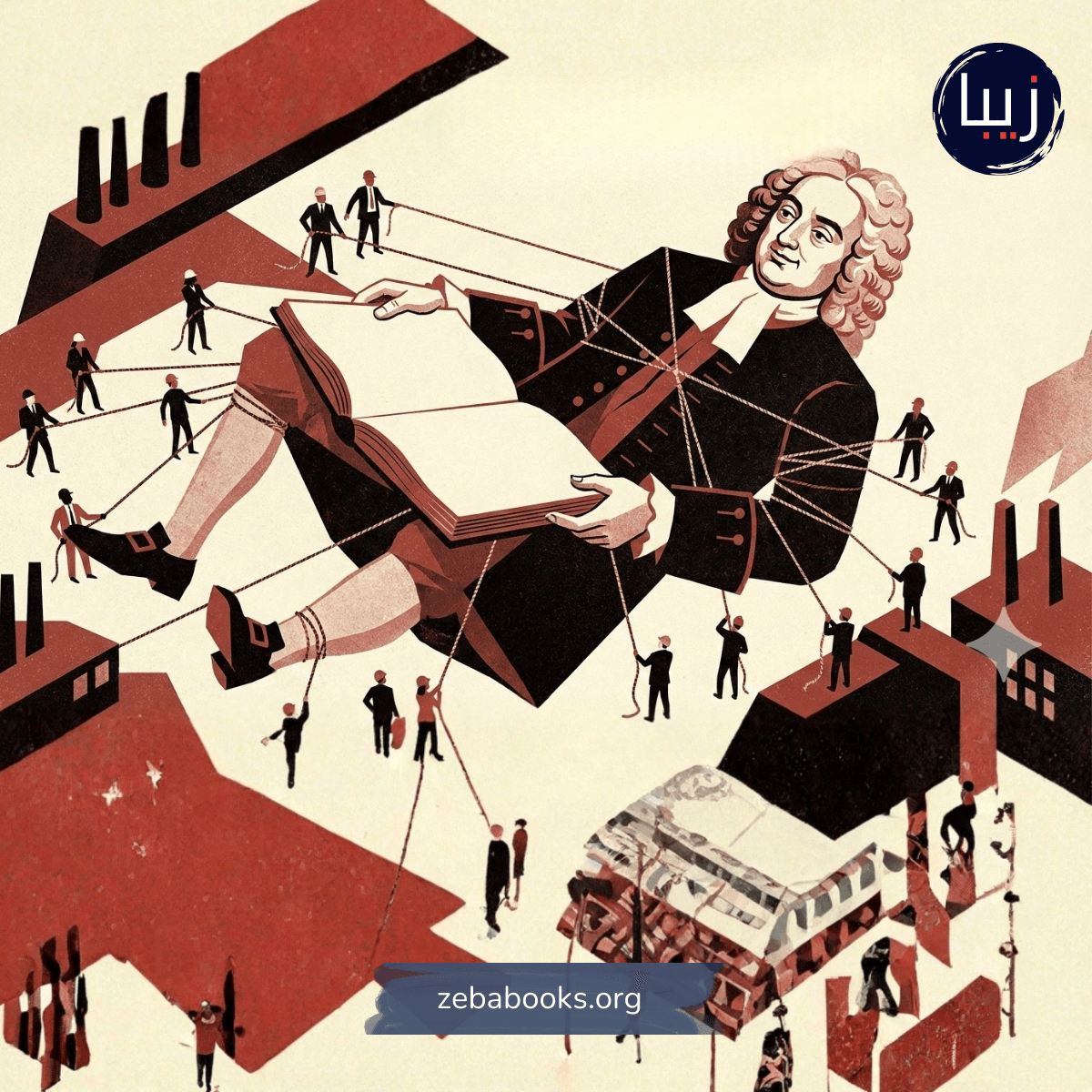
Jonathan Swift is usually considered a leading satirist in the English literary canon, with work that expresses a strong mistrust of intellectual arrogance and moral self-satisfaction. While his satire is frequently mistaken as comedic exaggeration, its power originates from a serious moral goal, not a display of lighter comedy. Swift’s judgments are delivered with a level of detail that is both personal and incisive, drawing on the frameworks of academia, politics, and religious organizations.
Swift’s key writings criticize the possibility for learning to deteriorate into abstraction and brutality when detached from humility and ethical considerations. This critique is organized around an intentional triad: lunacy, which contradicts claims of rational certainty; method, which emulates and subverts established scholarly traditions; and ridicule, which delivers moral judgment without open didacticism. Swift uses authoritative but unreliable narrative voices in A Tale of a Tub, Gulliver’s Travels, and A Modest Proposal to show the pitfalls of false learning and thought systems that are detached from the reality of human experience.
I. Historical and Intellectual Context.
To understand Swift’s critique of false learning, his satire must be placed within the intellectual atmosphere of the late seventeenth and early eighteenth centuries. Confidence in reason, expertise, and systematic knowledge inspired both the age’s ambitions and Swift’s work.
Enlightenment Confidence and the Authority of Reason
The age was defined by a belief in human reason and thorough research. Thinkers such as Bacon and Locke emphasized empirical methods and knowledge organization, whereas scientific and philosophical writing relied on specialized, authoritative language. Reason was considered a moral ideal rather than just a faculty.
The Growth of Professional Scholarship and Expert Culture
Scientific societies, such as the Royal Society, helped to institutionalize knowledge. Footnotes, treatises, and summaries were common forms of scholarship that asserted authority without regard for practical or ethical problems. Expertise became a symbol of authority, perhaps overshadowing wisdom.
Swift’s Skepticism about Abstract Learning
Swift was sceptical of learning as a dogma or abstraction. In A Tale of a Tub, he mocks pompous intellectuals; in Gulliver’s Travels, rational theories justify brutality; and in A Modest Proposal, economic reasoning reduces human beings to statistics.
II. Madness as a Satirical Device
In Swift’s satirical works, madness is used as a deliberate tool of criticism rather than a representation of chaos. Swift exposes the underlying weakness of claims of rational authority by portraying intellectual excess as instability, obsession, or skewed perception. Madness serves as both a key topic and a framing device, impacting how readers interpret knowledge, reason, and moral judgment.
Distorted Reason in Gulliver’s Travels
In Gulliver’s Travels, madness manifests itself through distorted cultures, which destabilize traditional rational standards. The societies of Lilliput and Brobdingnag force readers to rethink their assumptions about power dynamics and scale. Cruelty is presented as rational: political debates in Lilliput and intellectual pursuits in Laputa show how reason can be used to justify oppression and inefficiency.
When rational systems justify inhumanity, the line between rationality and irrationality blurs.
Intellectual Excess in A Tale of a Tub
The narrator’s irregular and digressive language in A Tale of a Tub parodies scholastic obsession. The reader is inundated with unnecessary digressions, self-congratulatory remarks, and defensive explanations, revealing how the quest for knowledge can deteriorate into confusion. The narrator’s instability highlights the dangers of scholarship that lacks both constraint and ethical considerations.
Madness Beyond These Texts
Swift’s critique is expanded upon in The Mechanical Operation of the Spirit, where religious zeal is shown as a type of madness, and A Modest Proposal, where the projector’s ostensibly rational reasoning conceals moral depravity. Throughout his work, false learning shows as passion and excess, a form of intellectual madness that mistakes calculation and systematization with actual wisdom.
III. Method: Swift’s Controlled Chaos
Swift’s satirical writings frequently appear chaotic, digressive, and formally unstable. However, this seeming disarray conceals a well-planned framework. His method entails employing academic writing techniques and then allowing them to fail. In Swift’s writing, irony is more than just a decorative feature; it is a guiding concept that influences narrative structure, tone, and authority.
Irony as a Structural Principle
Instead of criticizing ideas from the outside, Swift incorporates his critique into the approaches he emulates. His satire works by presenting sentences that appear scholarly, orderly, and authoritative, but gradually reveal their fundamental emptiness. This method necessitates careful construction. Each detour, aside, or technical description is intended to demonstrate how procedure can supplant meaning.
Irony works structurally, causing readers to question the organization and confirmation of knowledge.
Parody of Academic Method in A Tale of a Tub
Swift’s A Tale of a Tub is a prolonged spoof of scholarly form. The tale is packed with prefaces, apologies, footnotes, and digressions that all follow recognized academic standards. These features, purportedly intended to bring clarity and authority, ultimately lead to confusion and self-contradiction.
The narrator’s stress on uniqueness and education is weakened by his lengthy explanations and defensive remarks. Swift’s approach is purposeful. By highlighting the procedures of study, he demonstrates how an approach can overwhelm the content of an argument, as well as how intellectual frameworks can value their own power over the quest for truth.
Pseudo-Scientific Authority in Gulliver’s Travels
Gulliver’s Travels employs a similar method, albeit in a more subtle manner. Gulliver’s account is distinguished by its factual, almost scientific tone. He methodically documents measurements, societal customs, and social hierarchies from a supposedly objective standpoint. This ethnographic technique helps him validate the increasingly bizarre communities he discovers. The contrast between the narrative’s tone and content emphasizes the limitations of empirical observation when separated from moral considerations. Swift emulates the language of observation and classification, only to reveal its limitations in dealing with brutality, injustice, and irrational behavior.
Hollowing Out Learned Discourse
Swift’s strategy in these narratives entails adopting acquired discourse and then undermining it. By allowing form to undermine its own assertions, he demonstrates that approach alone cannot guarantee truth. What appears to be disorder is actually a precise satire of intellectual self-assurance that is not subjected to ethical examination.
IV. Mockery as a Tool for Moral Judgment
Swift’s use of ridicule is not purely for entertainment or ornament. Instead, it’s a purposeful moral weapon designed to reveal ethical flaws concealed under reasoned arguments. His humor succeeds by allowing cruelty, indifference, and stupidity to be presented in calm and rational terms. This strategy produces a shock of awareness, pushing readers to confront not just the satirical issues, but also their own engagement in methods of thought that favor logic above compassion.
Logical Cruelty in A Modest Proposal
Swift’s A Modest Proposal uses mocking effectively by following a logical structure. The article uses the language of economic planning and social transformation, working methodically from a stated problem to a proposed solution. Its moral shortcomings are a direct result of its reasonableness. The idea to regard destitute children as commercial goods is made with caution, calculation, and a superficial concern for efficiency.
The satirical voice represents what could be considered reasonable savagery. Swift demonstrates how abstract reasoning can normalize inhumane results by rejecting emotional appeals and adopting a tone of policy seriousness. The mocking is not in exaggeration, but in the exact replication of reformist discourse.
Political and Philosophical Mockery in Gulliver’s Travels
Mockery in Gulliver’s Travels operates in both political and philosophical contexts. In Lilliput, Swift mocks governmental regimes that are concerned with formality, faction, and minor distinctions. Office is bestowed based on physical performance rather than merit, revealing the ridiculous roots of political authority. The ridicule here is strong but controlled, focusing on structures of governance rather than individuals, which are supported by false rationalizations.
Among the Houyhnhnms, ridicule grows increasingly disturbing. Their commitment to pure reason appears wonderful until it justifies chilly management of life, including ideas for the extinction or control of the Yahoos. The philosophical ideal of rational perfection is found to be morally defective. Swift’s satire undermines the moral authority of reason by demonstrating its capacity for cruelty when empathy is lacking.
Mockery and Self-Reflection
Swift’s ridicule precludes readers from remaining neutral. By presenting ethical failings in familiar and recognized contexts, he drives the listener to accept the rationale he is critiquing. As a result, mocking serves as a catalyst for moral self-reflection. Readers are invited to question the assumptions that they hold as reasonable, efficient, or progressive. In Swift’s satire, laughter is secondary to judgment.
V. Voice, Persona, and the Unreliable Authority
Swift’s satire is especially effective because of his ability to create narrators who, despite their seeming confidence, erudition, and rationality, are ultimately untrustworthy. These voices have a dual purpose: they provide ideas while also exemplifying the dangers Swift seeks to expose. Swift demonstrates how easily authority may be produced by stylistic features such as tone, structure, and approach, rather than actual moral insight, by encouraging readers to trust the declarations of supposedly rational and educated speakers.
The Learned Author in A Tale of a Tub
The narrator of A Tale of a Tub portrays himself as a learned and original thinker anxious to demonstrate his intellectual scope. His writing style resembles that of an educated author who appreciates fresh ideas, intricate argumentation, and self-reference. However, his power is undermined by the very excesses he adores.
He regularly digresses, exaggerates minor topics, and consistently promotes his own intelligence. This self-absorption is a satire of scholarly hubris, demonstrating how intellectual domination may become a self-serving goal. The narrator’s unreliability is intentional, serving as a warning against associating verbal aptitude and academic organization with genuine comprehension.
Gulliver’s Changing Authority in Gulliver’s Travels
In Gulliver’s Travels, Swift complicates narrative authority by allowing Gulliver’s voice to change. Gulliver initially portrays himself as a reasonable observer, with exact observations and cautious evaluations. His forthright approach and great attention to detail give him credibility. However, as the story progresses, his perspective gets increasingly skewed.
By the end of his journey, Gulliver has entirely adopted the values of the Houyhnhnms, forsaking his own race. His authority diminishes as his confidence increases. Swift demonstrates how frequent exposure to rigorous ways of thinking can alter how we perceive the world.
The Reasonable Projector in A Modest Proposal
The speaker in A Modest Proposal is one of Swift’s most unsettling characters. Calm, logical, and practical, the projector speaks with the assurance of a social reformer, led by facts and efficiency. Although his tone is not harsh, his ideas are terrifying. This character emphasizes the moral peril of accepting ideas that appear reasonable only because they adhere to recognized expert judgments by employing utilitarian logic with no ethical constraints.
VI. Case Studies: Targets of False Learning
Swift’s satire repeatedly refers to distinct intellectual habits that he characterizes as forms of false learning. These are not simply errors of ignorance, but rather cultivated ways of thinking that gain legitimacy by tradition, method, or reputation. Swift creates a consistent critique of how knowledge can become separated from moral responsibility by continually addressing these tendencies across his works.
Pedantry and Scholastic Excess
Swift frequently criticizes pedantry, particularly the intellectual concern with commentary, classification, and interpretive exhibition. The abundance of prefaces, digressions, and explanatory notes in A Tale of a Tub detracts from the main plot. Learning becomes performative rather than instructional. Swift depicts academicians who mistake accumulation for understanding, and complication for depth. The upshot is intellectual stagnation masquerading as sophistication. Swift believes that pedantry replaces judgment with presentation, and interminable analysis with ethical participation.
Rational Systems Detached from Humanity
In Gulliver’s Travels, Swift broadens his critique to include rational systems that, despite their claims to universality, ignore the complexities of human experience. The Academy of Lagado is a prominent example of this risk. Its projectors are characterized as pursuing abstract advancements without regard for practical applicability or human misery. Experiments continue uninterrupted, despite their obvious futility, driven by the appeal of intellectual creativity. Similarly, the Houyhnhnms represent a type of intellectual perfection that lacks compassion. Their ostensibly wonderful society, however, eventually condones the manipulation and eradication of people they deem inferior. Swift demonstrates how cognitive coherence can coexist with moral blindness.
Abstract Social and Economic Planning
Swift’s A Modest Proposal provides a thorough critique of abstract planning. The projector reduces the social issue to a numerical calculation, thus reducing children to economic units.
His argument is internally consistent, efficient, and well-constructed. The unpleasant effect stems from its logical structure, not emotional excess. Swift’s criticism addresses a mode of thinking that prioritizes solutions above people and outcomes over decency. In this case, false learning manifests as policy language that lacks ethical understanding.
Intellectual Authority as Self-Preservation
Swift recognizes a common pattern in these examples. False learning exists to defend itself. Knowledge becomes a closed system when it is highly academic, used to create logical systems, or used in economic reasoning. It resists correction, disregards experience, and maintains its authority by intricacy. Swift’s satire underlines that learning without humility and moral responsibility is not only ineffective but also actively detrimental.
VI. Case Studies: Targets of False Learning
Swift’s satire repeatedly refers to distinct intellectual habits that he characterizes as forms of false learning. These are not simply errors of ignorance, but rather cultivated ways of thinking that gain legitimacy by tradition, method, or reputation. Swift creates a consistent critique of how knowledge can become separated from moral responsibility by continually addressing these tendencies across his works.
Pedantry and Scholastic Excess
Swift frequently criticizes pedantry, particularly the intellectual concern with commentary, classification, and interpretive exhibition. The abundance of prefaces, digressions, and explanatory notes in A Tale of a Tub detracts from the main plot. Learning becomes performative rather than instructional. Swift depicts academicians who mistake accumulation for understanding, and complication for depth. The upshot is intellectual stagnation masquerading as sophistication. Swift believes that pedantry replaces judgment with presentation, and interminable analysis with ethical participation.
Rational Systems Detached from Humanity
In Gulliver’s Travels, Swift broadens his critique to include rational systems that, despite their claims to universality, ignore the complexities of human experience. The Academy of Lagado is a prominent example of this risk. Its projectors are characterized as pursuing abstract advancements without regard for practical applicability or human misery. Experiments continue uninterrupted, despite their obvious futility, driven by the appeal of intellectual creativity. Similarly, the Houyhnhnms represent a type of intellectual perfection that lacks compassion. Their ostensibly wonderful society, however, eventually condones the manipulation and eradication of people they deem inferior. Swift demonstrates how cognitive coherence can coexist with moral blindness.
Intellectual Authority as Self-Preservation
Swift recognizes a common pattern in these examples. False learning exists to defend itself. Knowledge becomes a closed system when it is highly academic, used to create logical systems, or used in economic reasoning. It resists correction, disregards experience, and maintains its authority by intricacy. Swift’s satire underlines that learning without humility and moral responsibility is not only ineffective but also actively detrimental.
VII. The Enduring Impact of Swift’s Critique of False Learning
Jonathan Swift’s critique of misdirected learning remains relevant, transcending the literary and historical context of the early eighteenth century. Swift provides a framework for assessing the legitimacy of knowledge and the responsibility of its practitioners by exposing the ethical and practical flaws inherent in reason that is disconnected from human experience. His humorous work remains relevant in an era of specialized expertise, data-driven decision-making, and complex conceptual frameworks.
Foreseeing Modern Critiques
Swift’s satire anticipates contemporary concerns about the trustworthiness of experts and the abstraction of knowledge. His emphasis on exposing the ethical flaws that underpin logical processes can be read as a prelude to critiques of technocracy and bureaucratic governance.
In A Modest Proposal, for example, the projector’s detached, quantitative view of poverty predicts current discussions about data-driven policy, which frequently elevates statistical analysis above personal human experiences. Swift’s work serves as a cautionary tale, demonstrating how intellect devoid of ethical considerations can lead to the acceptance of brutal behaviours.
Influence on Later Satirists
Swift’s techniques influenced authors who examined ideological frameworks and intellectual pretentiousness. Both George Orwell’s Animal Farm and Aldous Huxley’s Brave New World mirror Swift’s use of narrative and structural irony to criticize the unquestioning application of logic. In these cases, matching the themes of Gulliver’s Travels, systems that appear reasonable and orderly are revealed to be mechanisms that perpetuate injustice and moral depravity. Swift’s use of logical presentation and ethical critique established satire as a tool for advocating social responsibility.
VIII. Conclusion
Jonathan Swift’s satirical works highlight the weakness of intellect when it is detached from ethical concerns. Using madness, technique, and ridicule, he criticizes the flaws of mistaken academia, including pedantry, abstract thought, and moral apathy, as seen in A Tale of a Tub, Gulliver’s Travels, and A Modest Proposal. His narrators, who project authority while yet being terribly untrustworthy, force readers to question the established institutions and voices that claim knowledge and exercise power.
Swift’s critique remains relevant in today’s culture, which is characterized by data-driven policy, specialized expertise, and technocratic governance. His works caution against learning that favours form, logic, or reputation over personal experience. As a result, Swift’s satire advocates for the unification of reason, humility, moral discernment, and practical wisdom.
References
- Swift, Jonathan. A Tale of a Tub.
- Swift, Jonathan. Gulliver’s Travels.
- Swift, Jonathan. A Modest Proposal.
- Rawson, Claude. Jonathan Swift: A Critical Introduction. Cambridge University Press.
- Fox, Christopher (ed.). The Cambridge Companion to Jonathan Swift. Cambridge University Press.
- Williams, Kathleen. Jonathan Swift and the Age of Compromise. University of Wisconsin Press.
- McBride, Kari Boyd. “Swift’s Satiric Method and the Problem of Authority.” ELH, Johns Hopkins University Press.
- Orwell, George. “Politics vs. Literature: An Examination of Gulliver’s Travels.” Polemic, 1946.
- Damrosch, Leopold. “Swift, Satire, and the Crisis of Authority.” Modern Critical Views on Jonathan Swift.
Liked what you read?