
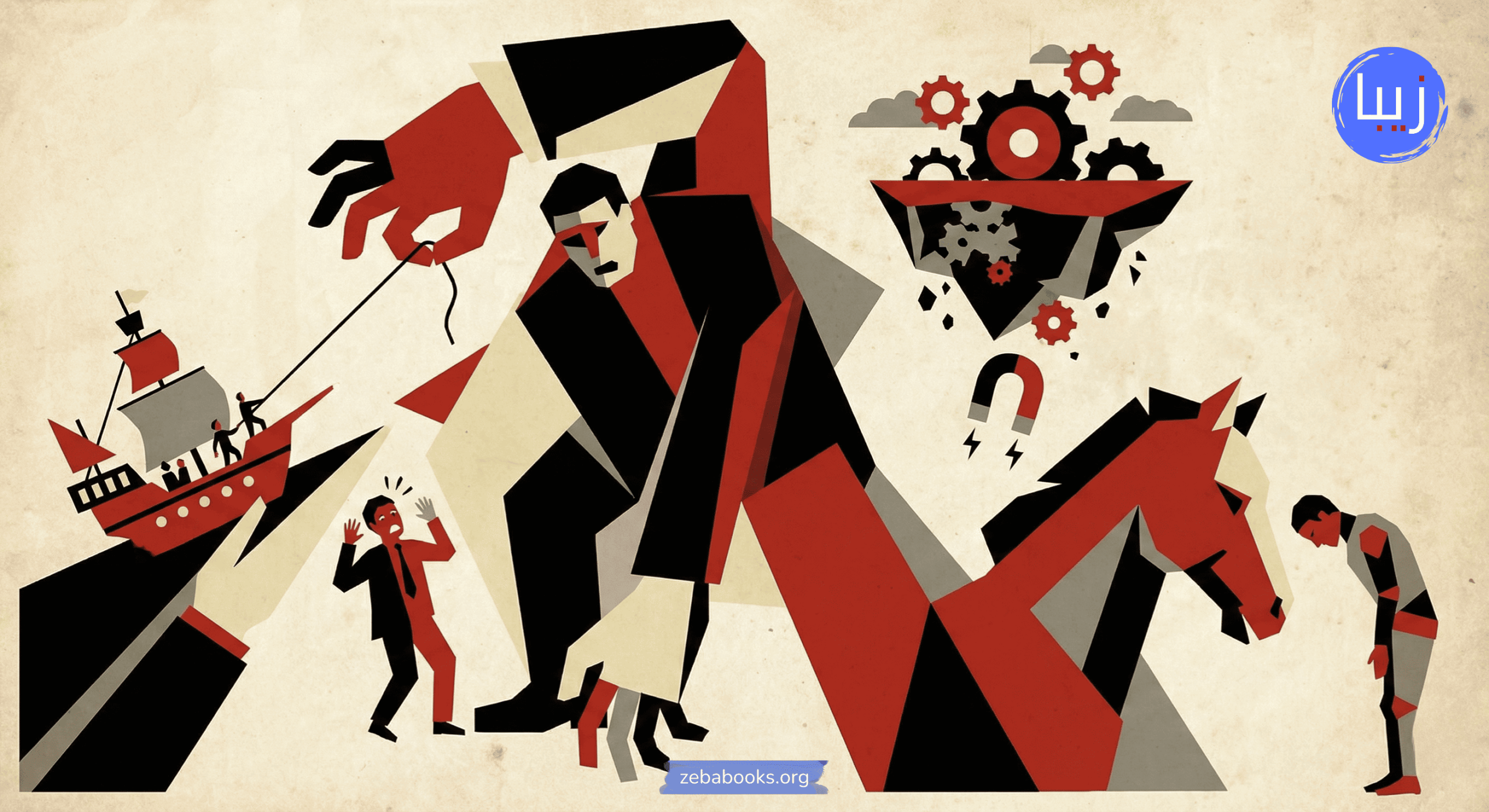
Gulliver’s Travels is best understood as a constant satirical assessment of humanity, rather than as a collection of individual stories or an early type of children’s literature. Each expedition serves as a unique trial, offering new evidence in Jonathan Swift’s meticulously planned thesis against human nature.
What appears to be a series of unrelated adventures on the surface is actually a skillfully designed moral deterioration. Swift begins by revealing political pettiness in Lilliput before moving on to the humiliation of human pride in Brobdingnag. He then intensifies his critique by exposing Laputa’s intellectual arrogance, and last, he delivers an unwavering ethical verdict in the land of the Houyhnhnm.
This evolution shows not a deepening of hatred, but a sharpening of moral consciousness.
Swift’s judgment is frequently mistaken as misanthropy; yet, it is based on a rigid moral framework that condemns mankind precisely because it has the capacity for superior behavior. The ultimate irony is Gulliver’s contempt for humanity, which embodies the extremism Swift warns his audience to avoid.
Voyage I – Lilliput: The Smallness of Political Life
The initial expedition serves as the foundation for Swift’s indictment of humanity. While Lilliput appears to be a hilarious and innocent place, its small size conceals a brutal political structure. Swift’s depiction of human civilization on a smaller scale highlights its moral flaws, encouraging the reader to evaluate them without the usual obedience to authority.
Scale as Moral Instrument
Swift’s most direct sarcastic instrument in Lilliput is scale. Although Gulliver is physically larger than the residents, their diminutive stature does not convey innocence or humility. Physical smallness, on the other hand, indicates a lack of morality. Despite their small size, Lilliputians demonstrate a high level of ambition, narcissism, and ruthlessness.
Their conflicts, legal codes, and punitive measures are reminiscent of European models, but the juxtaposition heightens their ridiculousness. Swift reduces the stature of the human body, undermining the imagined majesty of political power and exposing its moral flaws. The end effect is a culture marked by exaggerated pride.
Satire of Power and Governance
Lilliputian political life is defined by show rather than actual merit. Those seeking a high rank must demonstrate their commitment by performing risky rope dances in front of the emperor, risking injury or death. Promotion is predicated not on knowledge or justice, but on agility and unwavering obedience. Swift’s assessment is bolstered by the egg-breaking issue, a religious disagreement that has resulted in rebellions, executions, and international battles.
The first provocation is minor, but the consequences are deadly. Swift reveals that violence is not caused by substantial moral conflicts, but rather by an inflexible pride tied to minor differences. While power appears arbitrary, it is enforced with unwavering strictness.
Gulliver’s Position
Gulliver arrives in Lilliput as a logical, well-intentioned observer. He follows local laws, gives military help to the state, and initially respects its legal system. When he extinguishes a royal fire with urinating, he saves lives but violates etiquette, demonstrating the gap between moral awareness and institutional appraisal. Gulliver’s eagerness to serve demonstrates his own lack of awareness.
He conflates order with justice, and formality with virtue. His belief in power permits brutality to go unseen until it is directed at him.
Swift’s First Charge Against Humanity
Swift’s first formal criticism comes from Lilliput. He contends that human political activity is small, self-centered, and dangerously fixated on appearances. The biggest danger comes not from blatant violence, but from the disproportionate importance placed on little concerns. The moral flaw here is not a large-scale evil, but a smallness misinterpreted as dignity. Swift contends that when such smallness governs nations, the consequences are anything but minor.
Voyage II – Brobdingnag: The Grotesque Reality of the Human Body and Mind
The second voyage reverses Lilliput’s visual logic, intensifying Swift’s critique of humanity. Instead of a little society, Swift offers a big one, compelling Gulliver and the reader to feel an uncomfortable intimacy with the human body. What was stately from a distance became frightening up close.
Reversal of Perspective
In Brobdingnag, Gulliver is reduced to a spectacle. He is carried in a box, displayed for money, and treated alternately as a toy and a pet. His vulnerability replaces the power he had in Lilliput. This change removes any remaining illusion of human superiority. Gulliver’s intelligence and education offer him no advantage.
His survival hinges on external protection, thereby underscoring the precariousness of human standing when divorced from its usual scale and contextual framework.
The Body as Satirical Weapon
Swift’s narrative focuses on the physical qualities of the Brobdingnagian inhabitants. Gulliver’s findings include pores that resemble craters, skin riddled with flaws, and physiological functions amplified into disgusting spectacles. Instead of providing nourishment, a nurse’s breast becomes a geography of faults. These depictions are not superfluous. Swift uses bodily excess to challenge idealized notions of beauty and decency. The human figure, which is typically associated with pride and self-importance, is revealed as vulnerable, defective, and subtly unpleasant. Civilization has proven incapable of disguising biological facts.
Moral Judgment by the Brobdingnagian King
The most direct criticism comes from Gulliver’s interactions with the King. Gulliver, anticipating acceptance, proudly recalls European governance, judicial systems, and military practices. However, the King reacts with skepticism and moral revulsion. When Gulliver presents gunpowder as a technological triumph, the King is horrified, describing it as a gadget built purely for the mass murder of life. This repudiation recasts European progress as a type of organized cruelty. As a result, power and creativity are viewed as signs of moral inadequacy rather than marks of progress.
Gulliver’s Defensive Pride
Faced with this evaluation, Gulliver takes a defensive position. He defends the supremacy of his country and its institutions, even if his explanations crumble under scrutiny.
This marks a huge change in his character. He no longer acts as a distant observer, but rather as a champion of humanity. His pride trumps rational thought. The reader is given a viewpoint that Gulliver himself lacks: his allegiance obscures the facts being delivered.
Swift’s Second Charge
Swift’s second charge is more damning than the first one. Humanity is not just defined by pettiness, but it is also physically unattractive and morally contradictory. Nonetheless, it steadfastly maintains claims of grandeur and refinement. The primary fault in this case is pride, which demands dignity despite overwhelming evidence to the contrary.
Voyage III – Laputa and Beyond: The Madness of Abstract Reason
The third trip rejects the structured nature of its predecessors, instead embracing fragmentation and excess. Swift changes his emphasis from political institutions and physical characteristics to the workings of the mind. The narrative’s disorderly course reflects the disorganized application of reason that it criticizes.
A Fragmented Satirical Landscape
In contrast to Lilliput and Brobdingnag, this journey visits several regions with little narrative consistency. Laputa, Balnibarbi, Glubbdubdrib, Luggnagg, and Japan are all introduced in quick succession. This lack of unity is purposeful. Swift reflects the intellectual disorder that occurs when reason is separated from practical experience. The reader’s perception of stability reflects the disorder of the communities Gulliver explores.
Laputa and Abstract Reason
Laputa, a floating island, is entirely governed by mathematics and music. The people there are so preoccupied with abstract ideas that they are unable to manage fundamental social relationships. Servants use bladders to redirect their focus back to the topic. Their clothing is ill-suited, their structures are poorly constructed, and their administration is inefficient. Even if they believe they are academically superior, they are unable to apply their knowledge to real-world situations. Reason is independent, distinct from common sense and moral duty.
The Academy of Lagado
Swift’s most detailed mockery of Enlightenment scientific undertakings appears at the Academy of Lagado. Gulliver sees initiatives that try to collect sunlight from cucumbers, turn human waste into food, and teach mathematics through the eating of symbol-inscribed wafers. Buildings are built from the top down, and language is endangered due to a preference for tangible goods over verbal communication. These images mock the quest for knowledge for its own sake. In this setting, innovation becomes a type of insanity when its repercussions, practical applications, and human well-being are ignored.
Political and Historical Absurdities
Swift expands his critique to include historical and political follies. On Glubbdubdrib, Gulliver summons the souls of notable historical characters and discovers that official histories are riddled with lies, sycophancy, and fabrications. The truth has been abandoned for the sake of power.
In Luggnagg, the Struldbrugs appear to be immortal, yet their constant aging indicates that living without rejuvenation is a type of pain. A life without moral or spiritual development is unbearable. Human limitations beyond the scope of reason.
Swift’s Third Charge
Swift’s third charge aims at reason itself. When the intellect acts without humility or ethical limitations, it becomes a destructive force. The danger lies not in ignorance, but in arrogance disguised as advancement. Human reason, unanchored by moral goals, devolved into yet another tool of foolishness.
Voyage IV – The Houyhnhnms: The Final Verdict
The fourth journey represents the most critical and distressing aspect of Swift’s assessment of humanity. Satire evolves into a more distant and exact mode of evaluation. The known human context vanishes, giving way to a society that shows human nature through juxtaposition rather than hyperbole. What follows is not just a criticism, but a definitive statement.
Radical Ethical Contrast
The Houyhnhnms are intelligent beings characterized by order, temperance, and intellectual clarity. They are free from deception, avarice, and hubris. Their language lacks words for deception or lies, as such concepts are absent from their societal framework. Choices are made based on rational thought rather than emotional reaction or personal benefit.
Gulliver is struck by the Houyhnhnms’ consistency and balance, which appear to settle the moral ambiguity of human life. Their reason is more than a theory; it is a way of life that governs their decisions in all areas.
The Yahoos as Human Mirror
In contrast to the Houyhnhnms, the Yahoos are dirty and vicious animals motivated by primal cravings and desires. They battle over bright goods, attack each other without reason, and indulge in excess. Although they lack words and dignity, their behaviour demonstrates human flaws too clearly to ignore. Swift’s satirical cruelty stems from the recognition he imposes on the reader. By eliminating all sophisticated language and social sophistication, he lowers humanity to its most primitive instincts. The end result is highly unnerving, as the gap between people and Yahoos is uncomfortably little.
Gulliver’s Total Conversion
Gulliver’s association with the Houyhnhnms grows stronger, driving him to distance himself from humans. He is gradually embracing their attitudes, actions, and assessments. He compares people to Yahoos without hesitation. When he returns to England, he is repelled by his family, finding their scent and companionship unbearable. This rejection represents dissolution, not enlightenment. Gulliver has abandoned the human moral framework. His thirst for purity has annihilated empathy and moderation.
Limits of Rational Perfection
Despite their admirable characteristics, the Houyhnhnms are not flawless beings. They lack artistic expression, imagination, and emotional depth.
Their civilization does not tolerate individual variances or moral quandaries. Compassion is restricted by practical considerations, whereas attachment is motivated by utility. The recommendation to exterminate the Yahoos exemplifies the perils of ethical frameworks without empathy. When reason is pushed to its limit, it becomes cold and merciless.
Swift’s Final Charge
Swift’s last remark is both comprehensive and unresolved. He claims that humanity is morally imperfect, motivated by pride, desire, and self-deception. However, the option presented by pure reason is inhuman. Swift condemns humanity without citing the Houyhnhnms as an example. The reader is forced to choose between corruption and cold perfection, forcing them to ponder the difficult region where moral responsibility is required.
Conclusion
Gulliver’s Travels, over its four trips, delivers a cohesive and increasingly scathing moral critique of humanity. The narrative’s trajectory heightens the critique, moving from political farce to physical degradation, intellectual hubris to moral failure. Swift’s view is unambiguous. Humanity is portrayed as narrow-minded in its political dealings, disgusting in its physical vanity, reckless in its use of reason, and terribly self-deluded in its moral self-perception. However, this assessment is frequently misconstrued as simple misanthropy. Swift does not recommend rejecting the human experience.
Swift, on the other hand, uses Gulliver to demonstrate the dangers of such repudiation. Gulliver’s final disdain for humanity represents a moral absolutism devoid of empathy and balance. In his pursuit of perfect morality, he abandons his responsibilities. This is the work’s ultimate irony. Swift’s satire attempts to cause anguish rather than provide comfort, but it does not strive to obliterate hope. The reader is encouraged to reject both moral degradation and inflexible perfection, as well as to keep their humanity by accepting imperfection while being committed to moral consciousness.
References
- Swift, Jonathan. Gulliver’s Travels.
- Williams, Kathleen. Jonathan Swift and the Age of Compromise. University of Wisconsin Press.
- Damrosch, Leopold. “Swift, Gulliver, and the Human Condition.” Modern Critical Views: Jonathan Swift.
- Orwell, George. “Politics vs. Literature: An Examination of Gulliver’s Travels.” Polemic, 1946.
- Johnson, Samuel. “Swift.” Lives of the English Poets.
Liked what you read?