
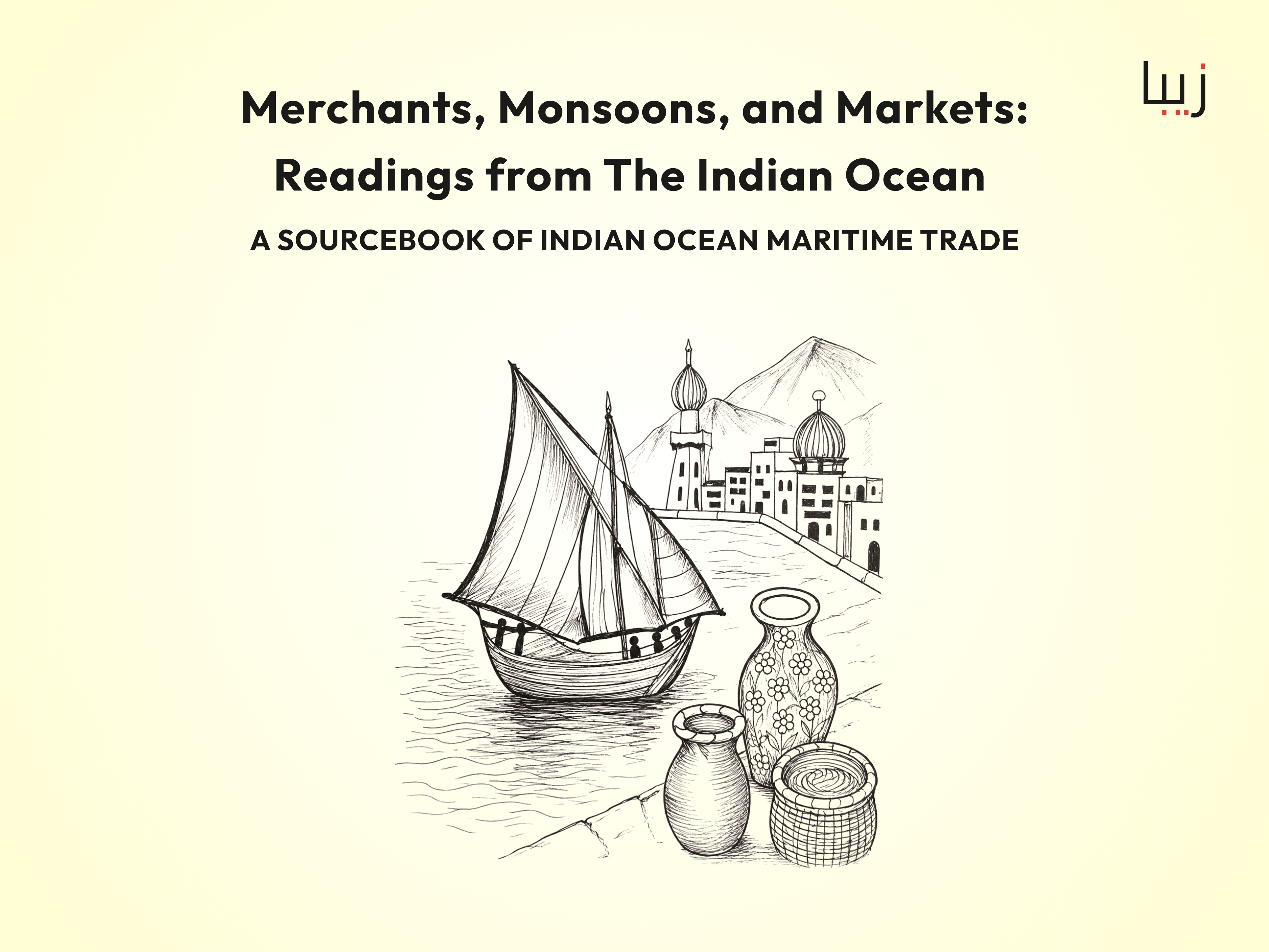
A documentary sourcebook of maritime trade, navigation, and cross-cultural encounters across the Indian Ocean littoral.
Overview
Long before the modern era began, the Indian Ocean was stitched together both by imperial borders as well as seasonal rhythms. The predictable shift of monsoon winds that guided dhows, junks, and galleys between East Africa, the Persian Gulf, the Malabar Coast, and the Indonesian archipelago remains an important artefact of study for historians today.
Merchants, Monsoons, and Markets: Readings from The Indian Ocean gathers primary accounts, travelogues, navigational logs, and mercantile records into a curated reader. From port customs and maritime law to personal memoirs of diaspora and pilgrimage, this volume offers students, scholars, and curious readers a direct encounter with the voices that shaped maritime trade for centuries.
Inside the Volume
- Primary Source Documents: Firsthand accounts as well as medieval-era scholarly commentary, translated and contextualized with critical introductions and marginal notes.
- Thematic Breadth: Explores seasonal meteorology, maritime technologies, commodities of exchange (spices, textiles, porcelain, timber), and port-city cosmopolitanism.
- Pedagogical Design: Structured specifically for undergraduate seminars, regional history courses, and independent study.
Table of Contents
Part I: Antiquity and Classical Seaways (1st Century CE – 6th Century CE)
- Western Indian Ocean Trade and Island Entrepôts (1st Century CE) (The Periplus of the Erythraean Sea)
- Cartography and Coastal Routes: Ptolemy in 19thCentury Indology (2nd Century CE) (Claudius Ptolemy, Ancient India as Described by Ptolemy)
- The Indian Ocean as a Global Transshipment Hub (6th Century CE) (Cosmas Indicopleustes, The Christian Topography)
Part II: Early Medieval Expansion and Maritime Lore (7th Century CE – 10th Century CE)
- The Buddhist Maritime Pilgrimage Circuit (7th Century CE) (Yijing, A Record of the Buddhist Religion)
- Abbasid Caliphate: From the Persian Gulf to Guangzhou (9th Century CE) (Sulaiman the Merchant and Abu Zaid al-Sirafi, Ancient Accounts of India and China)
- Seamanship, Shipwrecks, and Oceanic Lore: Historiography of the Kitāb ‘Ajā’ib al-Hind (10th Century CE) (Buzurg ibn Shahriyar, Kitāb ‘Ajā’ib al-Hind)
Part III: High Medieval Trade and Imperial Borderlands (12th Century CE – 14th Century CE)
- Red Sea Pilgrimages and Hajj Routes (12th Century CE) (Ibn Jubayr, The Travels of Ibn Jubayr)
- Song and Yuan Customs Administration and Canal Transport (13th-14th Century CE) (Zhao Rugua, Zhu Fan Zhi (13th c.) and Rashid al-Din, Jami’ alTawarikh (14th c.))
- Chinese Junks, Spices, and East Asian Emporia (Late 13th Century CE) (Marco Polo, The Book of Ser Marco Polo)
- Transoceanic Scholar Networks, Port Cities, and Shipboard Life (14th Century CE) (Ibn Battuta, The Travels of Ibn Battuta)
Part IV: The Era of European Arrival and Regional Emporia (15th Century CE – 16th Century CE)
- First Encounters on the Malabar Coast (Late 15th Century CE) (Journal of the First Voyage of Vasco da Gama (1497-1499))
- Italian Observations on Western Indian Manufacturing and Trade (Early 16th Century CE) (Ludovico di Varthema, Travels (1503-1508))
- Imperial Conquest, Fortresses, and Naval Chokepoints (Early 16th Century CE) (Afonso de Albuquerque, Commentaries)
- The Cosmopolitan Emporia: Calicut, Melaka, and Linguistic Intelligence (16th Century CE) (Duarte Barbosa, The Book of Duarte Barbosa (c. 1516))
- Portuguese Cartography, Goa Logistics, and Monsoon Sailing (Late 16th Century CE) (Jan Huyghen van Linschoten, Voyage (1580s-1590s))
- Early English Corporate Espionage in the East (Late 16th Century CE) (Ralph Fitch, The Travels of Ralph Fitch (1583-1591))
Part V: Corporate Monopolies, Gemways, and Island Empires (17th Century CE)
- Hormuz as the Gem of the Persian Gulf (Early 17th Century CE) (Pedro Teixeira, The Travels of Pedro Teixeira (1600s))
- Coral Reefs, Shipwrecks, and Transshipment Hubs (Early 17th Century CE) (François Pyrard of Laval, Voyage (1601-1611))
- Corporate Violence and the Spice Islands Monopoly (Early 17th Century CE) (John Jourdain, Journal (1608-1617))
- Diamond Mining, Currency Exchange, and Deccani Statecraft (Mid-17th Century CE) (Jean-Baptiste Tavernier, Travels in India (1630s-1660s))
- English Factory Networks and the Bay of Bengal (Late 17th Century CE) (Thomas Bowrey, A Geographical Account of Countries Round the Bay of Bengal (1669-1679))
Appendices
- Polity Profiles
- Port Profiles
- Commodity Profiles
Glossary of Terms
Bibliography
Supplementary Resources
Access companion teaching materials, cartographic references, and primary documents designed to accompany the print edition here.
Merchants, Monsoons, and Markets: Readings from the Indian Ocean
A Sourcebook of Indian Ocean Maritime Trade