
The Treaty of Jaffa ended the main wars of the Third Crusade, but not as a result of a definite military victory, but rather as a mutual recognition of fatigue within the system. Saladin’s attrition battle against Richard I of England in 1192 came to an unavoidable halt. Although the Crusaders were successful in taking the Levantine coast, attempts to conquer Jerusalem failed twice due to a lack of warriors who could hold control of the city if captured.[1] Saladin was under increasing pressure; his emirs were weary of frequent military deployment, and his logistical machine was on the point of failure.[2]
As stated by Bahā’ ad-Dīn ibn Shaddād “anxious at the prospect of further fighting,” and indeed Richard was sick and experiencing problems back home.[3] The ensuing peace was a handy tool for sustaining stability. Firstly, it took into consideration a territorial division where the Crusaders would continue controlling the coastal area between Tyre and Jaffa, while Saladin would govern Jerusalem, and the Christians would have access to the Holy Sepulchre unarmed.[4] Therefore, this tradition created a temporary legal framework that enabled the two sides to keep their strategic positions intact without spending excessively on an engagement that offered no more escalation possibilities.
The Iqta’ System: 12th-Century “Franchising” of Military Loyalty
The Iqta’ system was the structure and the finance of the statecraft that Saladin used in the 12th-century Islamic world. Instead of administering an exceedingly centralised empire with its own treasury receiving money from citizens and disbursing salaries, Saladin employed a decentralised statecraft system. This can be better understood through the franchise business model, in which the corporate headquarters (the Sultan) traded tax-collection powers for military support.
- The Franchise Territory (The Iqta’):Rather than paying salaries in cash, the Sultan delegated authority to a military leader, an Emir, to collect kharaj, or land taxes, in a specific territory, with no involvement from the treasury.
- The Buy-In (Military Obligation): In exchange for this localised revenue source, the Emir (known as a muqta’) was legally required to maintain, equip, and feed a set number of professional, heavy cavalrymen (asakir).
- The Activation (Mobilization): With the call to arms by the Sultan, the “franchisees” (Emirs) were expected to come to the battlefronts along with their armies in full mobilisation. As a result, Egypt’s agrarian wealth was quickly transformed into a massive, mobile army near Syria’s borders, free of a large centralised bureaucratic structure.
Legal Structure and Temporary Peace
While the Jaffa Treaty can be considered as an official truce (hudna), it is not intended to provide a lasting solution, but rather a temporary respite for the ideologically motivated fight that neither party was ready to renounce. As a result of the official ceasefire, both parties recognized their mutual claims as valid and were forced to engage in an official cooling-off period. In other words, the Jaffa Treaty made no attempt to resolve Jerusalem’s status.
The Logic of Controlled Violence
This deal worked by turning the battle into an administrative calculation. According to Baha al-Din Ibn Shaddad, the treaty was predicated on the necessity to dismantle the Ascalon fortifications, which served as an example of military de-escalation.[5] This was peacekeeping as a means of maintaining the status quo. Saladin was able to consolidate his fractured empire once the fight was called off, whereas Richard was able to preserve his last assets in the Levant before returning to his fragmented country.
Peace was more or less processual. It put limits on the use of force by drawing borders and forbidding raids, but did not relieve the underlying political tension.[6] The peace settlement was simply a way out of the “unsustainable military situation,” designed to avoid an out-of-control escalation but still keep the option open of further military conflict.[7] It can thus be said that Jaffa weakened one side without reconciling the two, showing that diplomacy in the medieval world could make distinctions between ideology and logistics.[8]
The Chaos of the Chancery: Factional Friction and Miscommunication
However, the journey leading up to the Treaty of Jaffa was far from straightforward, marked by upheaval and conflict. Both Richard I and Saladin had their own political ambitions, and the talks frequently teetered on the brink of failure due to internal political turmoil.
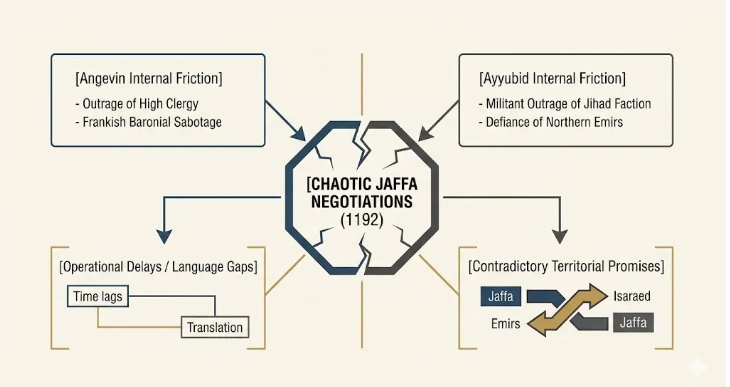
- Factional Interference and Sabotage: From the Crusader point of view, the French and the high ranks of the Latin Church were vehemently opposed to any deals that would leave Jerusalem under Muslim control, and they were spreading their disloyalty in the trenches while threatening to desert Richard entirely. In the same way, Saladin’s problem was immense due to opposition from his emirs and theologians.
- The Language Gap and Contradictory Promises: The communication process was carried out through multilayer translation, ranging from Old French/Anglo-Norman to Latin and finally to Arabic, which is why diplomatic embassies were constantly plagued by semantic shifts. Translation was always done by concealing or distorting offensive words, which led to contradictory promises: Richard assured his barons that the coast was merely an intermediate step before the coming war, while Saladin’s diplomats assured the emirs that it was only a containment area against the Westerners.
Territorial Arrangements and Strategic Geography
The boundary marking of Jaffa revealed a geography of tiredness because this was where the actual constraints on operations of both armies were defined. There wasn’t any elaborate vision of what was going to happen in the future in terms of the development of the Levant, but instead, there was an environment created that placed emphasis on defense and sustenance rather than philosophies and execution.
The Geopolitical Partition
Above all, the treaty guaranteed the preservation of the presence of the Franks in the region through the retention of the coastline territory. This made sure that the King of England, Richard I, would never sever the communication networks from the Latin East to Europe via sea transportation. The ports were much more than mere representations; they represented the lifeline of the Latin East, making it possible for its survival. While Salah ad-Din was able to retain control of the hinterland, he kept Jerusalem and its symbolism, but his Syrian and Egyptian territories remained separate.
Strategic Objectives and Defensive Realities
As mentioned earlier, Richard’s concern about the strategic value of harbors made it possible for him to capture Jaffa, Caesarea, and Acre, thus making it easier to arrange for the logistics needed for any reinforcements that may come later. On the contrary, Saladin valued his sovereign right to hold on to the hills of Judea and Jerusalem.
Both parties realized that the conditions of the settlement were imposed by logistics: Richard lacked an adequate land-based logistical link to attack the territory, and Saladin lacked the means to remove the Crusaders from the defended seaports.[9] The truce represented a de facto recognition that neither party has the additional resources required to defeat the other. The peace deal relieved Saladin’s fear about territorial disintegration.[10] It meant that the Crusaders had a narrow, but still defensible, political space in which to wait for reinforcements.[11] The lines formed at Jaffa were not the result of diplomatic compromise, but the physical signatures of two nations that had fought each other to a stalemate.[12]
Pilgrimage Access and Regulated Sacred Space
The Treaty of Jaffa was a very inventive diplomatic initiative since it allowed for limited access to Jerusalem without jeopardizing the Ayyubids’ political power. The provisions of the agreement allowed the Holy City to remain under the Ayyubids’ control while reopening its gates to the very people who wanted to seize it through fighting. It transformed the military conflict over the Holy Land into controlled access to a religious site.
The Mechanism of Devotional Entry
As a result of the final agreements, Christian pilgrims were granted permission to visit Jerusalem and perform their rites at the Holy Sepulchre. As previously stated, the provision did not represent any type of religious egalitarianism, but rather an accommodation of the Christian pilgrim’s need through the development of “protected travel arrangements,” which would be overseen by Saladin’s men.[13] The access was guaranteed unarmed, ensuring that the Crusaders’ spiritual requirements were addressed without jeopardizing the security of the Ayyubid troops in the Holy City.[14]
Sovereignty versus Sanctity
The agreement provided an opportunity for a large-scale decrease in religious conflicts due to the division of the rights to worship and govern. Consequently, Jerusalem became a Muslim political city with opportunities for Christian worship, thus enabling Saladin to preserve his political dominance without having to chase away all oppositionists. The order of property acquisition was also determined. The Ayyubid had control over the keys and the fortress, but the Christians still had the right to pass through.[15]
The Stabilization of the Sacred
The restricted access acted as an important diplomatic instrument, taking some of the venom out of the fight and resolving the Crusaders’ principal issue without sacrificing any territory. It provided legitimacy for those among them who had taken a religious pledge to return home, thereby contributing to the end of hostilities.[16] As a result, the pact set an important precedent for dealing with sacred sites through legal quotas rather than ongoing military action.[17]
Strategic Constraints behind the Settlement
The Treaty of Jaffa came out of the structural pressures imposed on both the tired empires. In 1192, the idealism of the Third Crusade had been lost due to the harshness of medieval wars, and thus both Saladin and Richard were operating in an environment where escalating the conflict would have endangered their sovereignty. The treaty did not arise from any sense of sudden religious awakening, but as a consequence of realizing that their machines of war were on the verge of breaking down.
Richard’s Atlantic and Logistic Tether
For the king of England, the crusade was a quest with alarmingly low rewards. He created a “maritime dependency” by relying on sea connections to supply his troops, which meant that each serious push into the Judean countryside was a bet against starvation.[18] In addition to the logistical challenge of crossing the Jerusalem road, Richard had to deal with the Crusaders’ deteriorating cohesiveness, as well as a depleted purse after extended mobilization efforts. More importantly, political factors throughout Europe, including the threat by King Philip II of France, who was joined by his brother John, made Richard’s stay there politically risky.[19]
Saladin’s Fragmenting Coalition
Saladin faced all kinds of stresses, yet he dealt with them all equally. The rebellion of the emirs, who had been mobilized for five years, was evidence of “cumulative military fatigue”.[20] The Ayyubid financial systems were already deteriorating as a result of the need to support a standing army against a coastal rival who would not back down lightly. Furthermore, the Sultan needed to unify an empire made up of fragmented areas in Mesopotamia and Egypt, so either Saladin’s presence there or the transfer of resources elsewhere was required to preserve order and avert further issues.[21] Endless regional defense was quickly becoming a costly and unworkable policy.
The Threshold of Governability
This treaty was made possible because the price of victory exceeded the price of compromise. The two rulers realized that “catastrophic defeat” or even “pyrrhic victory” would result in overstretching and the breakdown of logistics at home.[22] Compromise through negotiation became the only process through which they could maintain their fighting ability and political power. By 1192, the option of flexibility no longer existed, and operational necessities compelled the two greatest historical rivals to make survival the priority over total victory.[23]
Long-Term Consequences and Political Reconfiguration
The Treaty of Jaffa was not the death knell for the Crusader impetus, but rather a shift in its geometry. With the split of the Levant being fully established by law, a containment strategy became the default. The end result was a completely new political geography of the eastern Mediterranean, one that served as a template for maintaining a Latin presence in the region for the next century.
Survival in the Coastal Fringe
As far as the consequences of the agreement go, first of all, the Crusader states were preserved within a limited maritime framework. Without the Judaean hinterland, the Latin Kingdom would consist solely of walled coastal enclaves. This “strategic foothold” would not be merely a matter of prestige but would provide direct access to the Mediterranean Sea, thus ensuring support from the West. The treaty marked the end of Crusader expansionist policies in favor of maintenance and possible future activities.[24]
The Ayyubid Consolidation
For Saladin, the result served to affirm the legitimacy that he had fought so hard to achieve symbolically. There was no incentive for another round of Crusades because Jerusalem remained intact, and pilgrimage was permitted. In this manner, Saladin managed to redirect his energy toward extending his political power rather than defending against it. The fact that Saladin survived the time when the Crusaders had been restricted to the coastal regions showed that he could resist the power of the European monarchy.[25]
An Institutionalized Equilibrium
It created an unstable equilibrium that would define the regional relations for many years ahead. The agreement was successful in transforming the struggle into something beyond pure warfare into an orderly territorial disagreement. By 1192, geopolitics had reached the level at which:
- There were no longer any theological arguments for controlling the Holy City, but the urgent necessity to settle the question through violence had subsided.
- Reconquest was formally replaced by a strategy of containment and regional influence.
- The Levant region was now to become one that emphasized peaceful coexistence rather than unrestrained escalation.[26]
In other words, the Treaty of Jaffa came out as a pragmatic compromise of immense significance. Indeed, it gave enough space for both sides, but the main reason behind the dispute was never dealt with — hence why Jerusalem would always remain its epicenter.[27]
Conclusion: Diplomacy as Strategic Containment
In the end, the Treaty of Jaffa brought to an end the Third Crusade through negotiation, and not conquest, thus confirming the old maxim of necessity making diplomats. Each one of these clauses was, in essence, a safety valve for the area of tension it was meant to address. Legal stipulations meant no increase in tensions, the drawing of boundaries reflected the military truth, while the promise of pilgrimage was a valve for the religious passion.[28] Through these clauses, it was possible for both Saladin and Richard to pull back from the brink of total ruin and yet satisfy their strategic needs.[29]
The long-term effect of the treaty was not to foster a spirit of reconciliation but rather a stable structure of hostile control. It managed to create a climate in which violence was contained, legitimacy maintained, and coexistence conceivable without the sacrifice of one’s essential ideological ideals . Both sides recognized the immovable realities of weariness, logistics, and political impotence, yet refused to abandon their underlying ideas about Holy Land possession.[30] By 1192, all sides realized that the war was approaching a point where the expenses of fighting would considerably outweigh the potential gains.[31] In essence, the Treaty of Jaffa acknowledged that both parties were unable to finish the fight through victory, and it was the greatest method to wage war when both sides were completely spent.
This macro-level geopolitical standstill was a direct result of the Ayyubid regime’s domestic infrastructure being pushed into deeper, systemic bankruptcy.
References
- Asbridge, Thomas. The Crusades: The Authoritative History of the War for the Holy Land, (accessed April 28, 2026).
- Tyerman, Christopher. God’s War: A New History of the Crusades. (accessed April 28, 2026).
- Ibn Shaddad, The Rare and Excellent History of Saladin.
- Itinerarium Peregrinorum et Gesta Regis Ricardi, trans. Nicholson.
- Ibn Shaddad, The Rare and Excellent History of Saladin.
- Itinerarium Peregrinorum et Gesta Regis Ricardi, trans. Nicholson.
- Lyons and Jackson, Saladin.
- Phillips, Jonathan. The Life and Legend of the Sultan Saladin. (accessed April 29, 2026).
- France, John. Victory in the East: A Military History of the First Crusade. (accessed April 29, 2026).
- Ibn Shaddad, The Rare and Excellent History of Saladin.
- Itinerarium Peregrinorum et Gesta Regis Ricardi, trans. Nicholson.
- Asbridge, The Crusades.
- Itinerarium Peregrinorum et Gesta Regis Ricardi, trans. Nicholson.
- Ibn Shaddad, The Rare and Excellent History of Saladin.
- Hillenbrand, Carole. The Crusades: Islamic Perspectives. (accessed April 27, 2026).
- Tyerman, God’s War.
- Asbridge, The Crusades.
- France, Victory in the East.
- Itinerarium Peregrinorum et Gesta Regis Ricardi, trans. Nicholson.
- Ibn Shaddad, The Rare and Excellent History of Saladin.
- Lyons and Jackson, Saladin.
- Asbridge, The Crusades.
- Tyerman, God’s War.
- Ibid.
- Ibn Shaddad, The Rare and Excellent History of Saladin.
- Phillips, The Life and Legend of the Sultan Saladin.
- Asbridge, The Crusades.
- Ibn Shaddad, The Rare and Excellent History of Saladin.
- Itinerarium Peregrinorum et Gesta Regis Ricardi,
- Tyerman, God’s War.
- Asbridge, The Crusades.